Today's
EarthStation1.com 15% Off Commemorative Memorial Title: WJSV Radio
Entire Broadcast Day 9/21/1939 MP3 CD, Download, USB Drive
Today, May 31, 2026
May 31: National Macaroon Day: -- Macaron
or Macaroon? Regardless, it's most assuredly an American holiday
since the macaroon is definitely an American cookie! However, the
confusion is natural. The origins of macaron and macaroon are the
same and many of the ingredients overlap. Both use a fair amount
of sugar to make these delightful confections. Both use egg whites
to make the cookies rise and give them a light texture. However,
the French macaron (which actually originated in Italy) uses
almond flour at its base while the American macaroon uses shredded
coconut to great effect. We have Mrs. Esther Levy to thank for
popularizing the great macaroon. In 1871 Mrs. Levy published the
"First Jewish American Cookbook." She originally
published this recipe in the chapter on 'cakes' as there was not a
chapter on cookies. However, it's understandable, as the texture
of a macaroon isn't very cookie-like. It is soft and a little
chewy, more like a cake than a cookie. However, the bite-size
serving is most definitely cookie-like. Macaroons deserve to be
celebrated and recognized for their own characteristics. Coconut
was substituted for almond flour when the first coconut palms
planted in Florida began to yield fruit. Thus macaroons are not
only tasty little delights, they were an early exercise in the
locavore movement, eating produce grown close to home. On Sale @
15% Off Discount Till Midnight PT!
https://store.earthstation1.com/wjsv-radio-mp3-cd-entire-broadcast-day-sep-3211939.html
Today's
EarthStation1.com 15% Off Commemorative Memorial Title: Archival
Cartoon Classics #4 Cartoon Menagerie! MP4 Video Download DVD
Today, May 31, 2026
May 31: World Parrot Day: -- A day that
celebrates the parrot as a phenomenon. The order Psittaciformes
includes 398 species of birds divided into 92 genera. Parrots are
mostly found in tropical and subtropical regions. The order
Psittaciformes is subdivided into three superfamilies: the
'Psittacidae' also known as the 'true parrots,' the 'cockatoos,'
and the 'Strigopidea' which are known as the 'New Zealand
parrots.' One-third of all parrot species are currently
endangered, making them the birds with the highest aggregate
extinction risk than any other bird group. Parrots have a
pantropical distribution, with several species also living in
temperate regions of the Southern Hemisphere. Some characteristic
features of parrots include strong, curved beaks, an upright
stance, strong legs, and clawed feet. A large number of parrots
are vividly colored, with some being multi-colored. In the visual
spectrum, most parrots exhibit little to no sexual dimorphism.
They are the most variable-sized bird order, concerning their
length. The earliest record of a 'pet parrot' in the British Isles
dates back to 1504 when Henry VIII owned an African Gray Parrot.
The Age of Exploration lasted from the early 15th century to the
early 17th century, and it was marked by European ships sailing
around the world in search of new trading routes. Several animals
had been brought back from these trips, for different purposes.
Parrots from India, Africa, and South America were some of the
most common imports from these exploration trips. Not only are
parrots colorful and easy to domesticate, but they also provided
relatively easy transportation on the long, uncomfortable sea
voyages back to Europe. Only a few people were aware of the needs
of parrots, and this ignorance resulted in the death of many birds
in transit. However, parrots did much better than more delicate
bird species. The records of birds kept in menageries, the
precursor to zoos, private collections of the elite, and artwork
of birds from the 16th to 18th centuries list parrots, pheasants,
ostriches, and other long-lived and relatively easy-to-keep birds.
Most pet parrots are relatively "fresh out" of the wild,
as they are only a few generations removed from the wild, and few
owners allow parrots the opportunity to express and exhibit their
most basic bird instincts, such as flying, flocking, and
mate-finding. On Sale @ 15% Off Discount Till Midnight PT!
https://store.earthstation1.com/archival-cartoon-classics-4-cartoon-menagerie-mp4-video-download-d44.html
Today's
EarthStation1.com 15% Off Commemorative Memorial Title: Go For
Broke WWII Japanese-American 442nd Infantry DVD, MP4, USB Drive
Today, May 31, 2026
May 31: Asian American And Pacific
Islander Heritage Month (Asian/Pacific American Heritage Month):
-- Asian American And Pacific Islander Heritage Month ends.
Officially name changed from Asian Pacific American Heritage
Month) in 2009, Asian American And Pacific Islander Heritage Month
recognizes the contributions and influence of Asian Americans and
Pacific Islander Americans to the history, culture, and
achievements of the United States. The Asia-Pacific area
encompasses all of the Asian continent and the Pacific islands of
Melanesia (New Guinea, New Caledonia, Vanuatu, Fiji and the
Solomon Islands), Micronesia (Marianas, Guam, Wake Island, Palau,
Marshall Islands, Kiribati, Nauru and the Federated States of
Micronesia) and Polynesia (New Zealand, Hawaiian Islands, Rotuma,
Midway Islands, Samoa, American Samoa, Tonga, Tuvalu, Cook
Islands, French Polynesia and Easter Island). Like most
commemorative months, Asian American And Pacific Islander Heritage
Month originated with Congress. In 1977 Reps. Frank Horton of New
York introduced House Joint Resolution 540 to proclaim the first
ten days in May as Pacific/Asian American Heritage Week. In the
same year, Senator Daniel Inouye introduced a similar resolution,
Senate Joint Resolution 72. Neither of these resolutions passed,
so in June 1978, Rep. Horton introduced House Joint Resolution
1007. This resolution proposed that the President should "proclaim
a week, which is to include the seventh and tenth of the month,
during the first ten days in May of 1979 as 'Asian/Pacific
American Heritage Week.'" This joint resolution was passed by
the House and then the Senate and was signed by President Jimmy
Carter on October 5, 1978 to become Public Law 95-419. This law
amended the original language of the bill and directed the
President to issue a proclamation for the "7 day period
beginning on May 4, 1979 as 'Asian/Pacific American Heritage
Week.'" During the next decade, presidents passed annual
proclamations for Asian/Pacific American Heritage Week until 1990
when Congress passed Public Law 101-283, which expanded the
observance to a month for 1990. Then in 1992, Congress passed
Public Law 102-450, which annually designated May as Asian/Pacific
American Heritage Month. The month of May was chosen to
commemorate the immigration of the first Japanese to the United
States on May 7, 1843, and to mark the anniversary of the
completion of the transcontinental railroad on May 10, 1869. The
majority of the workers who laid the tracks were Chinese
immigrants. On Sale @ 15% Off Discount Till Midnight PT!
https://store.earthstation1.com/go-for-broke-dvd-japaneseamerican-442nd-infantry-division-w442.html
Today's
EarthStation1.com 15% Off Commemorative Memorial Title: Groucho
Marx & The Marx Bros OTR Radio Show MP3 Set DVD, Download, USB
Today, May 31, 2026
May 31: National Smile Day: -- Wear your
best smile to this party! Founded by dentists Dr. Tim Stirneman
and Jim Wojdyla of Compassionate Dental Care in Lake in the Hills,
Illinois, this day is meant to, you guessed it, "Share with
the world what the power of a healthy smile can do!" The best
part, this day heralds the beginning of National Smile Month! The
history of the smile can be traced back to monkeys and apes,
according to primatologist Signe Preuschoft. These animals bare
their teeth in a facsimile of a smile to show dominance or warn
off predators. The theory is that humans copied this behavior and,
over time, the smile evolved to show amusement and enjoyment.
Research indicates that on the way to portraying happiness, smiles
were a way of attracting mates among early humans. If you've ever
wondered why older portraits often showed unsmiling people, it was
because people in that era had a lot of tooth rot caused by sugar
and a poor diet. Plus, more common was the aristocratic perception
that smiling and laughing was indecorous, and showed a lack of
self-control or good manners. One of the few exceptions was
Leonardo da Vinci's "Mona Lisa," although the portrait's
ambiguity is part of its fame. As dentistry and an attitude of
authenticity developed, people began smiling even in portraits,
this time with their teeth on display. Studies of yearbook
photographs over the years point to the breadth of smiles
increasing over the years. The study indicates that because
participants had to hold the pose for longer periods in the
earlier days of photography, their smiles gradually dimmed. The
prevalence of smiling in the recent past is linked to culture and
traditions and varies from country to country. Some regions with
high individualism and low population density had a higher
incidence of people who smiled. A study found that the biggest
reason people smile, however, can be attributed to a country's
tradition of diverse immigration over time. So places like Brazil
and the United States, where people do not share common customs or
languages, see higher incidences of smiles. The study states that
this is because the smile is part of a universal language. A
French neurologist, Guillaume Duchenne, who studied the mechanism
of facial expression, discovered there are two types of smiles: a
Duchenne smile and a non-Duchenne smile. The former smiles with
the eyes or is a genuine smile, whereas the latter is an
ambiguous, non-genuine, or simply polite smile. On Sale @ 15% Off
Discount Till Midnight PT!
https://store.earthstation1.com/groucho-marx-and-marx-brothers-mp3-dvd-all-known-radio-show3.html
Today's
EarthStation1.com 15% Off Commemorative Memorial Title: Butt Out:
The Life & Death Of TV Cigarette Advertising DVD, MP4, USB
Today, May 31, 2026
May 31: World No Tobacco Day: -- Each
year, the World Health Organization (WHO) holds this day of
observice with the goal of spreading awareness about the risks of
tobacco use and how we can make the world tobacco free. Roughly 6
million people die from tobacco-related ailments every year. And
that number is projected to rise to over 8 million by 2030. But
this is by no means a guarantee. The Sustainable Development
Agenda aims to reduce deaths from noninfectious diseases by a
third. Diseases linked to tobacco are on the list, so if we hit
the target, 2030 will be a year to celebrate (oh yea!)-not only
for our health, but the size of our wallets. Your average smoker
drops around $4,000 on cigarettes annually. Imagine all of the
other cool holidays you could enjoy with that money (we have a few
suggestions, just saying). So let's use World No Tobacco Day as a
launching pad to a brighter and less smokey future! World No
Tobacco Day is an initiative by the World Health Organization and
is observed on May 31 every year. The campaign aims to spread
awareness about the dangers of tobacco and its negative impact on
health, as well as the exploitation of the nicotine industry that
is geared towards the youth in particular. It also aims to reduce
the diseases and deaths caused by tobacco consumption. The World
No Tobacco Day theme for 2021 is "Commit to Quit." The
Member States of the World Health Organization created World No
Tobacco Day in 1987 as a response to the global tobacco crisis and
the diseases and deaths caused by the epidemic. The World Health
Assembly passed Resolution WHA40.38 in 1987, calling for April 7
to be "World No-Smoking Day." Next, Resolution WHA42.19
was passed in 1988, issuing May 31 as an annual observance of
World No Tobacco Day. The World Health Organization reports 8
million deaths every year due to the consumption of tobacco.
Tobacco is the leading cause of respiratory disorders like chronic
obstructive pulmonary disease, tuberculosis, and other lung
diseases. In 2008, the WHO banned any kind of advertisement or
promotion of tobacco. As the world's most populated country, China
is the leader in the cigarette industry. More than 30% of the
total cigarettes in the world were produced and consumed in China
in 2014. On Sale @ 15% Off Discount Till Midnight PT!
https://store.earthstation1.com/butt-out-life-amp-death-of-tv-cigarette-commercials-dvd-mp4-us4.html
Today's
EarthStation1.com 15% Off Commemorative Memorial Title: The
Machine That Changed The World The Computer + Bonus 3 MP4s Or DVDs
Today, May 31, 2026
May 31: Autonomous Vehicle Day: --
Embrace the future of travel on Autonomous Vehicle Day, celebrated
yearly on May 31. While self-driving cars have until recently only
lived in our imaginations (or on the silver screen), technology
and science have combined to bring us the dawn of a new era in
travel, when automobiles can go from one place to another without
anyone touching the wheel. To stay updated with the latest
autonomous inventions follow the top automobile journalist who
brings sources and research for better understanding. Founded to
honor the advances in the autonomous vehicle industry and to
recognize the potential opportunities thereof, Autonomous Vehicle
Day shows us how close we are to a sea change in the way the world
travels. Autonomous vehicles are not a new concept; the legend of
flying carpets is the earliest form of human imagination dreaming
up a driverless vehicle. Multiple technology innovations over the
years have brought autonomous vehicle development to where it is
today such as the guidance system of torpedoes and General Motors'
1958 Chevy, which had pick-up coils allowing this model to steer
itself. In fact, this journey began almost 100 years ago, when
army engineer Francis Houdina attached a radio control system to a
car, allowing him to control it via remote control. To demonstrate
features like turning, moderating speed, and honking, he drove
this car around the streets of New York. Apparently, the
driverless car spooked passersby, who took to calling it the
'phantom car'. Of course, innovation in autonomous vehicles is not
limited to cars alone. Local Motors developed Olli, which is an
automated electric, cognitive shuttle, which can transport up to
12 passengers at a time. Additionally, self-driving passenger
vehicles, self-driving buses, and autonomous commercial trucks are
also being developed. The Department of Defense is also
purportedly developing self-driving military vehicles.
Entrepreneurial ecosystem platform Emerging Prairie and American
technology talk show host Marlo Anderson founded Autonomous
Vehicle Day in 2017. On Sale @ 15% Off Discount Till Midnight PT!
https://store.earthstation1.com/the-machine-that-changed-the-world-the-computer-dvd-mp4-downloa4.html
Today's
EarthStation1.com 15% Off Commemorative Memorial Title: The French
Revolution Series + Irish Rebellion & You Are There MP4 DVD
Today, May 31, 2026
May 31, 1795: The Age Of Enlightenment
(The Enlightenment, The Age Of Reason): The Age Of Revolution: The
Atlantic Revolutions: The French Revolution: The French First
Republic (French: Premiere Republique; Revolutionary France,
Officially The French Republic [French: Republique Francaise]):
The National Convention (French: Convention Nationale): The Reign
Of Terror: (French: La Terreur, "The Terror"): The
Revolutionary Tribunal (French: Tribunal Revolutionnaire) (The
Popular Tribunal): -- The court which was instituted by the
National Convention for the trial of political offenders, The
Revolutionary Tribunal, which had become one of the most powerful
engines of the infamous Reign of Terror, is suppressed. One of the
earliest cases brought to The Tribunal led to its most famous
acquittal. On April 13, 1793 Girondin deputes brought an
accusation against Jean-Paul Marat. Crucially, this involved
waiving the immunity enjoyed until then by members of the
Convention (Marat was himself a depute). Not only did the case
against Marat collapse, but two days after his case was brought,
members of the Paris Commune responded by bringing a case to The
Tribunal against 22 leading Girondins. This case was dismissed,
but the principle that Convention members could be tried by The
Tribunal was an important one, and ultimately led to the Girondin
leaders being tried and executed in October 1793. During the
months when Montane served as its President, The Tribunal dealt
with 178 accused. 53% of these were set free after initial
examination by a judge, without a full trial, while a further 17%
were tried and acquitted by a jury. 5% were convicted and
sentenced to imprisonment or deportation, and 25% were sentenced
to death. From its formation up to September 1793, The Tribunal
heard 260 cases and handed down 66 death penalties. As a result,
it was criticized as ineffective by some Jacobins. The Law Of
Suspects (September 17, 1793) greatly increased the number of
prisoners who were imprisoned and might be brought to trial.
Between October and the end of 1793 The Tribunal issued 177 death
sentences. Similar Tribunaux Revolutionnaires were also in
operation in the various French departments. However, on April 16,
1794 (27 Germinal Year II) the Convention approved a report by
Saint-Just proposing the abolition of the existing revolutionary
tribunals in individual departements and requiring all suspects to
be sent to the main tribunal in Paris, due to reports of
corruption in the provincial tribunals. On May 21, 1794 the
government decided that the judicial system would be centralized,
with almost all the tribunals in the provinces closed and all the
trials held in Paris. The provincial tribunals which were allowed
to continue their work were Bordeaux, Arras, and Nimes in the
south, as well as Arras and Cambrai in the north. Following the
attempted assassinations of Convention members Jean-Marie Collot
d'Herbois on May 23 and Maximilien Robespierre on May 25, 1794, on
June 10, (22 Prairial Year II) the so-called "Prairial Laws"
were passed. These limited trials in the Revolutionary Tribunal to
three days. They also prevented the Revolutionary Tribunal from
calling witnesses, or from allowing defense counsel. Juries were
to convict or acquit entirely on the basis of the accusation and
the accused's own defense. Further, the new laws confined The
Tribunal to only two possible verdicts - acquittal or death.
Finally, the law cancelled all previous legislation on the same
subject. Without being explicit, this removed the immunity of
members of the Convention which up till then had protected them
from summary arrest and required that the Convention itself vote
to send any of its members to trial. Three days after the Prairial
laws were passed, the guillotine was moved out of Paris. It had
previously stood on the Place du Carrousel, was then moved to the
Place de la Revolution, and then again to the Place St Antoine and
later to the Place du Trone-Renverse. As the Revolutionary
Tribunal accelerated the pace of executions in Paris, it became
impractical to have it in the city. The powers of the
Revolutionary Tribunal were granted by the Convention, and there
was only limited criticism of it. Royalists, emigres and
federalists were clearly opposed to The Tribunal and its workings,
but since public criticism in support of the monarchy in Paris or
in the press would be regarded as treasonable, it barely existed.
At the same time, there were periodic demands from Enrages and
Hebertists that The Tribunal accelerate its work and condemn more
of the accused. Among the first to speak up publicly against The
Tribunal was Camille Desmoulins in his short-lived journal, "Le
Vieux Cordelier". As a result of his criticisms he was
expelled from the Jacobin Club. Later he was arrested, tried and
executed together with Danton. On the eve of his execution, Danton
expressed his regret for having advocated The Tribunal. "It
was just a year ago that I was the means of instituting the
Revolutionary Tribunal; may God and man forgive me for what I did
then; but it was not that it might become the scourge of
humanity." On Sale @ 15% Off Discount Till Midnight PT!
https://store.earthstation1.com/the-french-revolution-dvd-3-part-tv-documentary-serie3.html
Today's
EarthStation1.com 15% Off Commemorative Memorial Title: Walt
Whitman Documentary Biography DVD, Video Download, USB Drive
Today, May 31, 2026
May 31, 1819: #BOTD: #HBD! Walt Whitman,
American poet, essayist, humanist and journalist (d. March 26,
1892) is #born Walter Whitman Jr. in Long Island, New York. Walter
"Walt" Whitman he was a part of the transition between
transcendentalism and realism, incorporating both views in his
works. Whitman is among the most influential poets in the American
canon, often called the father of free verse. His work was very
controversial in its time, particularly his poetry collection
Leaves of Grass, which was described as obscene for its overt
sexuality. Born in Huntington on Long Island, Whitman worked as a
journalist, a teacher, a government clerk, and in addition to
publishing his poetry, he was a volunteer nurse during the
American Civil War. Early in his career, he also produced a
temperance novel, Franklin Evans (1842). Whitman's major work,
Leaves of Grass, was first published in 1855 with his own money.
The work was an attempt at reaching out to the common person with
an American epic. He continued expanding and revising it until his
death in 1892. After a stroke towards the end of his life, he
moved to Camden, New Jersey, where his health further declined.
When he died at age 72, his funeral became a public spectacle.
Walt Whitman died having suffered a stroke towards the end of his
life in Camden, New Jersey aged 72; his funeral became a public
spectacle, and he was buried at Harleigh Cemetery in Camden, New
Jersey. On Sale @ 15% Off Discount Till Midnight PT!
https://store.earthstation1.com/walt-whitman-dvd-biography-poetry-documentary.html
Today's
EarthStation1.com 15% Off Commemorative Memorial Title: Ulysses S.
Grant & The Battle Of The Wilderness DVD MP4 USB Drive
Today, May 31, 2026
May 31, 1864: The American Civil War (The
Civil War, The War Between The States): The Eastern Theater Of The
American Civil War: The Overland Campaign (Grant's Overland
Campaign, The Wilderness Campaign): The Battle of Cold Harbor: --
The Army Of Northern Virginia under Confederate General Robert E.
Lee engages The Army Of The Potomac under Union Generals Ulysses
S. Grant and George Meade. It was one of the final battles of
Union Lt. Gen. Ulysses S. Grant's Overland Campaign, and is
remembered as one of American history's bloodiest, most lopsided
and most unnecessary battles. Thousands of Union soldiers were
killed or wounded in a hopeless frontal assault against the
fortified positions of Confederate Gen. Robert E. Lee's army.
Grant said of the battle in his memoirs, "I have always
regretted that the last assault at Cold Harbor was ever made. ...
No advantage whatever was gained to compensate for the heavy loss
we sustained.". It was an impressive defensive victory for
Lee, but it was his last in the war. On Sale @ 15% Off Discount
Till Midnight PT!
https://store.earthstation1.com/ulysses-s-grant-amp-the-battle-of-the-wilderness-dvd-mp4-usb-driv4.html
Today's
EarthStation1.com 15% Off Commemorative Memorial Title: Barnum's
Big Top: P. T. Barnum's Circuses + 2 Bonuses MP4 Download DVD
Today, May 31, 2026
May 31, 1866: #BOTD: #HBD! John Ringling,
American entrepreneur who is the best known of the seven Ringling
brothers (d. December 2, 1936) is #born John Nicholas Ringling in
McGregor, Iowa. John Ringling, in addition to owning and managing
many of the largest circuses in the United States, was also a
rancher, a real estate developer and an art collector. Five
Ringling brothers, including John, merged their Ringling Bros
World's Greatest Shows with Barnum & Bailey Circus to create
Ringling Bros. and Barnum & Bailey Circus, a merger that
shaped the modern circus into the form it took for its last
century of existence. The merger created a virtual monopoly of
traveling circuses, and they became a staple of the entertainment
world until 2017, when weakening attendance, many animal rights
protests, and high operating costs forced them to perform their
last show on May 21, 2017, at Nassau Veterans Memorial Coliseum,
closing after 146 years. John Ringling died of of pneumonia in New
York City, aged 70. He is buried at The John And Mable Ringling
Museum Grounds in Sarasota, Florida. He was the last Ringling
brother to die, as well as the longest-lived of the Ringling
brothers, being the only brother to reach his 70s. Once one of the
world's wealthiest men, he died with only 311 USD in the bank. At
his death, he willed his Sarasota mansion, the museum, and his
entire art collection to the state of Florida. The house, Ca
d'Zan, and the John and Mable Ringling Museum of Art offer
visitors a glimpse into the lifestyle of the Roaring 20s, a
renowned art collection and library. Another of John's legacies is
the Ringling College of Art and Design, which asked to adopt his
name because of the cultural influence of the museum and its
collection. A museum devoted to the Ringling Brothers Circus has
been established on the estate also. On Sale @ 15% Off Discount
Till Midnight PT!
https://store.earthstation1.com/barnum39s-big-top-dvd-p-t-barnum-and-his-circuses-dvd-mp4-394.html
Today's
EarthStation1.com 15% Off Commemorative Memorial Title: The
Johnstown Flood Documentary DVD, Video Download, USB Flash Drive
Today, May 31, 2026
May 31, 1889: Natural Disasters: Natural
Disasters In The United States: Floods: Floods In The United
States: The Johnstown Flood (The Great Flood Of 1889): -- #DOTD:
#RIP: Over 2,200 people die after a dam fails and sends a 60-foot
(18-meter) wall of water over the town of Johnstown, Pennsylvania.
The Johnstown Flood was the catastrophic failure of the South Fork
Dam on the Little Conemaugh River 14 miles upstream of Johnstown
(where it is known as the great flood of 1889), which released
14.55 million cubic meters of water with a flow that temporarily
equaled the Mississippi River, destroying the town. The flood
accounted for 17M USD (580M USD in 2023) in damage. The American
Red Cross, led by Clara Barton and with fifty volunteers,
undertook a major disaster relief effort. Support for victims came
from all over the U.S. and eighteen foreign countries. After the
flood, survivors suffered a series of legal defeats in their
attempts to recover damages from the dam's owners. This led to
American law changing from a fault-based regime (legal
blameworthiness and responsibility) to one of strict liability
(for which guilty intentions does not have to be proven in
relation to a guilty act). On Sale @ 15% Off Discount Till
Midnight PT!
https://store.earthstation1.com/the-johnstown-flood-the-great-flood-of-1889-in-johnstown-pennsylv1889.html
Today's
EarthStation1.com 15% Off Commemorative Memorial Title: Complete
Fred Allen Radio Shows MP3 Set DVD, Audio Download, USB Drive
Today, May 31, 2026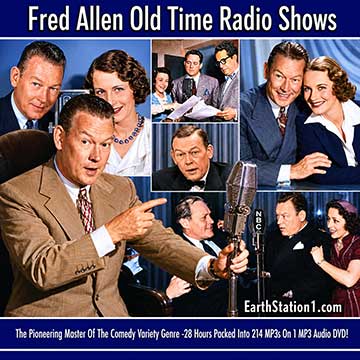
May 31, 1894: #BOTD: #HBD! Fred Allen,
American comedian, radio host, game show panelist, and author (d.
March 17, 1956) is #born John Florence Sullivan in Cambridge,
Massachusetts, to Irish Catholic parents. Fred Allen was host of
the absurdist, topically pointed radio program The Fred Allen Show
(1932-1949), which made him one of the most popular and
forward-looking humorists in the Golden Age of American radio. His
best-remembered gag was his long-running mock feud with friend and
fellow comedian Jack Benny, but it was only part of his appeal; he
was simultaneously radio's most admired comedian and the most
frequently censored. A master ad libber, Allen often tangled with
his network's executives (and often barbed them on the air over
the battles) while developing routines whose style and substance
influenced fellow comic talents, including Groucho Marx, Stan
Freberg, Henry Morgan and Johnny Carson; his avowed fans also
included President Franklin D. Roosevelt and novelists William
Faulkner, John Steinbeck and Herman Wouk (who began his career
writing for Allen). Allen was honored with stars on the Hollywood
Walk of Fame for contributions to television and radio. Fred Allen
died of a heart attack on a Saturday night while taking his
customary late night stroll up New York's West 57th Street on
Saturday night, aged 61. He is buried at Gate Of Heaven Cemetery
in Hawthorne, New York. On Sale @ 15% Off Discount Till Midnight
PT!
https://store.earthstation1.com/fred-allen-radio-mp3-dvd-complete-broadcast3.html
Today's
EarthStation1.com 15% Off Commemorative Memorial Title: The Boer
Wars: First Boer War & Second Boer War MP4 Video Download DVD
Today, May 31, 2026
May 31, 1902: New Imperialism: The
Scramble For Africa: The Boer Wars: The Second Boer War (The Boer
War, The Anglo-Boer War, The South African War): The Battle Of
Magersfontein: The Treaty Of Vereeniging: -- The Treaty of
Vereeniging ends The Second Boer War between the South African
Republic and the Orange Free State, on the one side, and the
United Kingdom on the other. This settlement provided for the end
of hostilities and eventual self-government to the Transvaal
(South African Republic) and the Orange Free State as British
colonies. The Boer republics agreed to come under the sovereignty
of the British Crown and the British government agreed on various
details. On April 9, 1902, with safe passage guaranteed by the
British, the Boer leadership met at Klerksdorp, Transvaal. Present
were Marthinus Steyn, Free State president and Schalk Burger
acting Transvaal president, with the Boer generals Louis Botha,
Jan Smuts, Christiaan de Wet and Koos de la Rey attending to first
consider the treaty. When it was signed on May 31st of that year,
the settlement entailed the end of hostilities and the surrender
of all Boer forces and their arms to the British, with the promise
of eventual self-government to the Transvaal (South African
Republic) and the Orange Free State as colonies of the British
Empire. The Boer Republics agreed to come under the sovereignty of
the British Crown and the British government agreed on various
details including the following 12 points: 1) All Boer fighters of
both republics had to give themselves up; 2) All combatants would
be disarmed; 3) Everyone had to swear allegiance to the Crown; 4)
No death penalties would be dealt out; 5) A general amnesty would
apply; 6) The use of Dutch would be allowed in the schools and law
courts; 7) To eventually give the Transvaal and the Orange Free
State self-government (civil government was granted in 1906 and
1907, respectively); 8) To avoid discussing the native (Black)
enfranchisement issue until self-government had been given; 9) To
pay the Boers 3M PSD in reconstruction aid; 10) Property rights of
Boers would be respected; 11) No land taxes would be introduced;
and 12) Registered private guns would be allowed. Subsequent to
the British government giving the Boer colonies self-government,
The Union Of South Africa was created on the eight anniversary of
the treaty's signing, May 31 1910. The Union gained relative
independence under the 1926 Imperial Conference and de facto
independence under the 1931 Statute of Westminster. Under the
strain of British as well as international opposition to Apartheid
in South Africa, the country withdrew from the British
Commonwealth and became a republic on May 31, 1961 -- the 59th
annivesary of the treaty signing and the 51st anniversary of the
founding of The Union Of South Africa -- and thereby severing all
political ties with Great Britain; however, though still a
republic, South Africa rejoined the Commonwealth in 1994, a month
after The 1994 South African General Election, elections that were
the first in South Africa in which citizens of all races were
allowed to take part, and were therefore also the first held with
universal suffrage. On Sale @ 15% Off Discount Till Midnight PT!
https://store.earthstation1.com/the-boer-wars-first-boer-war-amp-second-boer-war-mp4-video-download-dv4.html
Today's
EarthStation1.com 15% Off Commemorative Memorial Title: The Golden
Age Of Comedy 5 Album Set CD, MP3, USB Stick
Today, May 31, 2026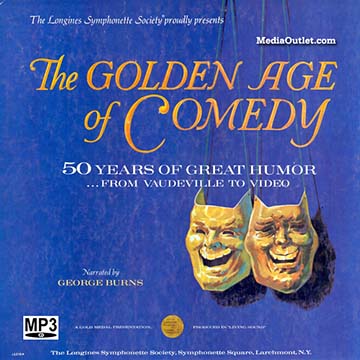
May 31, 1908: #BOTD: #HBD! Don Ameche,
American actor, comedian and vaudevillian (d. December 6, 1993) is
#born Dominic Felix Amici in Kenosha, Wisconsin. His father,
Felice Amici, was a bartender from Montemonaco, Ascoli Piceno,
Marche, Italy. His mother, Barbara Etta Hertel, was of Scottish,
Irish, and German ancestry. After playing in college shows, stock,
and vaudeville, he became a major radio star in the early 1930s,
which led to the offer of a movie contract from 20th Century Fox
in 1935. As a handsome, debonair leading man in 40 films over the
next 14 years, he starred in comedies, dramas, and musicals. In
the 1950s he worked on Broadway and in television, and was the
host of NBC's International Showtime from 1961 to 1965. Returning
to film work in his later years, Ameche enjoyed a fruitful revival
of his career beginning with his role as a villain in Trading
Places (1983) and won the Academy Award for Best Supporting Actor
for his performance in Cocoon (1985). Don Ameche died at his son
Don, Jr.'s house in Scottsdale, Arizona, of prostate cancer at age
85. He was cremated and his ashes are buried at Resurrection
Catholic Cemetery in Asbury, Iowa. On Sale @ 15% Off Discount Till
Midnight PT!
https://store.earthstation1.com/golden-age-of-comedy-narrated-by-george-burns-5-album-set-mp3-53.html
Today's
EarthStation1.com 15% Off Commemorative Memorial Title: Civil
Rights OTR: Destination Freedom, New World A-Coming CD MP3 USB
Today, May 31, 2026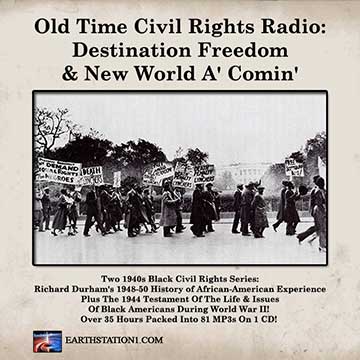
May 31, 1909: Civil Rights Movements: The
American Civil Rights Movement (1954-1968): Civil Rights
Organizations (Civil Rights Movement Organizations): African
American Civil Rights Organizations (Civil Rights Movement
Organizations): The National Association For The Advancement Of
Colored People (NAACP): -- The National Negro Committee,
forerunner to the National Association for the Advancement of
Colored People (NAACP), convenes for the first time. The National
Negro Committee (formed: New York City, May 31 and June 1, 1909 -
ceased: New York City, May 12, 1910) was created in response to
the Springfield Race Riot Of 1908 against the black community in
Springfield, Illinois. Prominent black activists and white
progressives called for a national conference to discuss African
American civil rights. They met to address the social, economic,
and political rights of African Americans. This gathering served
as the predecessor to the National Association for the Advancement
of Colored People, which was formally named during the second
meeting in May 1910. On Sale @ 15% Off Discount Till Midnight PT!
https://store.earthstation1.com/destination-freedom-new-world-a39comin39-mp3-cd-civil-rights-39393.html
Today's
EarthStation1.com 15% Off Commemorative Memorial Title: Apartheid
Documentaries Collection DVD, Video Download, USB Drive
Today, May 31, 2026
May 31, 1910: South Africa: The History
Of South Africa: The South Africa Act (The South Africa Act 1909)
(The Founding Of The Union Of South Africa): -- The Parliament Of
The United Kingdom creates the Union Of South Africa from the
British Cape Colony, Colony of Natal, Orange River Colony, and
Transvaal Colony when The South Africa Act comes into force. The
Act also made provisions for potentially admitting Rhodesia as a
fifth province of the Union, but Rhodesian colonists rejected this
option in a referendum held in 1922. The Act was the third major
piece of legislation passed by the British Parliament with the
intent of uniting various British colonies and granting them some
degree of autonomy. Earlier, the British North America Act, 1867
had united three colonies (the Province of Canada (which was split
into Ontario and Quebec) Nova Scotia, and New Brunswick) and the
Commonwealth of Australia Constitution Act, 1900 had united the
Australian colonies. On Sale @ 15% Off Discount Till Midnight PT!
https://store.earthstation1.com/apartheid-documentaries-dvd-racial-segregation-in-south-africa.html
Today's
EarthStation1.com 15% Off Commemorative Memorial Title: The
Mexican Revolution 1910-1920 DVD, Video Download, USB Drive
Today, May 31, 2026
May 31, 1911: 20th Century Revolutions:
The Mexican Revolution: -- The Mexican Revolution begins as
President of Mexico Porfirio Diaz is forced from office and flees
the country for Spain. Despite public statements favoring a return
to democracy and not running for office, Diaz reversed himself and
ran again for an eighth term of office in 1910. His failure to
institutionalize presidential succession, as he was by then 80
years old, triggered a political crisis between the Cientificos (a
circle of technocratic advisors to Diaz) and the followers of
General Bernardo Reyes, allied with the military and with
peripheral regions of Mexico. After Diaz declared himself the
winner of the 1910 presidential election, his electoral opponent,
Francisco I. Madero, issued a call for armed rebellion against
Diaz, leading to the outbreak of the Mexican Revolution. After the
Federal Army suffered a number of military defeats against
Madero's forces, Diaz was forced to resign in May 1911 and went
into exile in France, where he died four years later. On Sale @
15% Off Discount Till Midnight PT!
https://store.earthstation1.com/the-ragged-revolution-mexican-revolt-191019101920.html
Today's
EarthStation1.com 15% Off Commemorative Memorial Title: Combat At
Sea Documentary Series + 2 Bonuses MP4 Video Download DVDs
Today, May 31, 2026
May 31, 1916: The European Civil War:
World War I: The First European War (The European Theater Of World
War I): The Western Front Of World War I: Naval Warfare Of World
War I: The Battle Of Jutland (German: Skagerrakschlacht, "The
Battle Of The Skagerrak"): -- The British Grand Fleet under
the command of John Jellicoe, 1st Earl Jellicoe and David Beatty,
1st Earl Beatty engage the Imperial German Navy under the command
of Reinhard Scheer and Franz von Hipper in the largest naval
battle of the war, which proves indecisive. The Battle of Jutland
(German: Skagerrakschlacht, the Battle of Skagerrak) was a naval
battle fought by the British Royal Navy's Grand Fleet under
Admiral Sir John Jellicoe, against the Imperial German Navy's High
Seas Fleet under Vice-Admiral Reinhard Scheer during the First
World War. The battle unfolded in extensive manoeuvring and three
main engagements (the battlecruiser action, the fleet action and
the night action), from 31 May to 1 June 1916, off the North Sea
coast of Denmark's Jutland Peninsula. It was the largest naval
battle and the only full-scale clash of battleships in that war.
Jutland was the third fleet action between steel battleships,
following the smaller but more decisive battles of the Yellow Sea
(1904) and Tsushima (1905) during the Russo-Japanese War. Jutland
was the last major battle in world history fought primarily by
battleships. Germany's High Seas Fleet intended to lure out, trap,
and destroy a portion of the Grand Fleet, as the German naval
force was insufficient to openly engage the entire British fleet.
This formed part of a larger strategy to break the British
blockade of Germany and to allow German naval vessels access to
the Atlantic. Meanwhile, Great Britain's Royal Navy pursued a
strategy of engaging and destroying the High Seas Fleet, thereby
keeping German naval forces contained and away from Britain and
her shipping lanes. The Germans planned to use Vice-Admiral Franz
Hipper's fast scouting group of five modern battlecruisers to lure
Vice-Admiral Sir David Beatty's battlecruiser squadrons into the
path of the main German fleet. They stationed submarines in
advance across the likely routes of the British ships. However,
the British learned from signal intercepts that a major fleet
operation was likely, so on 30 May Jellicoe sailed with the Grand
Fleet to rendezvous with Beatty, passing over the locations of the
German submarine picket lines while they were unprepared. The
German plan had been delayed, causing further problems for their
submarines, which had reached the limit of their endurance at sea.
On the afternoon of 31 May, Beatty encountered Hipper's
battlecruiser force long before the Germans had expected. In a
running battle, Hipper successfully drew the British vanguard into
the path of the High Seas Fleet. By the time Beatty sighted the
larger force and turned back towards the British main fleet, he
had lost two battlecruisers from a force of six battlecruisers and
four powerful battleships - though he had sped ahead of his
battleships of 5th Battle Squadron earlier in the day, effectively
losing them as an integral component for much of this opening
action against the five ships commanded by Hipper. Beatty's
withdrawal at the sight of the High Seas Fleet, which the British
had not known were in the open sea, would reverse the course of
the battle by drawing the German fleet in pursuit towards the
British Grand Fleet. Between 18:30, when the sun was lowering on
the western horizon, back-lighting the German forces, and
nightfall at about 20:30, the two fleets - totalling 250 ships
between them - directly engaged twice. Fourteen British and eleven
German ships sank, with great loss of life. After sunset, and
throughout the night, Jellicoe manoeuvred to cut the Germans off
from their base, hoping to continue the battle the next morning,
but under the cover of darkness Scheer broke through the British
light forces forming the rearguard of the Grand Fleet and returned
to port. Both sides claimed victory. The British lost more ships
and twice as many sailors but succeeded in containing the German
fleet. However, the British press criticised the Grand Fleet's
failure to force a decisive outcome, while Scheer's plan of
destroying a substantial portion of the British fleet also failed.
Finally, the British strategy of denying Germany access to both
the United Kingdom and the Atlantic did succeed, which was the
British long-term goal. The Germans' "fleet in being"
continued to pose a threat, requiring the British to keep their
battleships concentrated in the North Sea, but the battle
reinforced the German policy of avoiding all fleet-to-fleet
contact. At the end of 1916, after further unsuccessful attempts
to reduce the Royal Navy's numerical advantage, the German Navy
accepted that its surface ships had been successfully contained,
subsequently turning its efforts and resources to unrestricted
submarine warfare and the destruction of Allied and neutral
shipping, which - along with the Zimmermann Telegram - by April
1917 triggered the United States of America's declaration of war
on Germany. Subsequent reviews commissioned by the Royal Navy
generated strong disagreement between supporters of Jellicoe and
Beatty concerning the two admirals' performance in the battle.
Debate over their performance and the significance of the battle
continues to this day. On Sale @ 15% Off Discount Till Midnight
PT!
https://store.earthstation1.com/combat-at-sea-dvd-set-all-12-naval-warfare-tv-shows-6-di126.html
Today's
EarthStation1.com 15% Off Commemorative Memorial Title: Black
Civil Rights Films: African-American History DVD, MP4, USB Stick
Today, May 31, 2026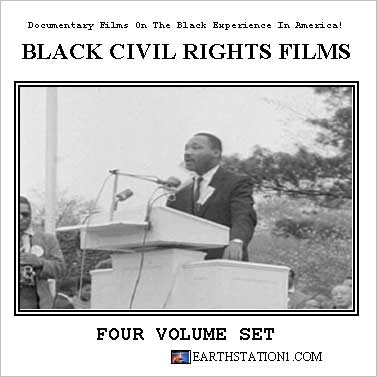
May 31 - June 1, 1921: White Supremacy:
Terrorism: Anti-Black Racism: Anti-Black Racism In The United
States: Race Riots: Race Riots In The United States: Terrorism:
The Tulsa Race Massacre (The Tulsa Race Riot, The Black Wall
Street Massacre): : -- One of the worst incidents of racial
violence in the history of the US occurs during two days of civil
unrest in Tulsa, Oklahoma. The official death toll was given as
39, but other estimates of black fatalities vary from 55 to about
300. The Tulsa Race Riot, sometimes referred to as the Tulsa
Massacre, Tulsa Pogrom, or Tulsa Race Riot Of 1921, took place
between May 31 and June 1, 1921, when a white mob attacked
residents and businesses of the African American community of
Greenwood in Tulsa, Oklahoma. This is considered one of the worst
incidents of racial violence in the history of the United States.
The attack, carried out on the ground and by air, destroyed more
than 35 blocks of the district, at the time the wealthiest black
community in the U.S.. More than 800 people were admitted to
hospitals and more than 6,000 black residents were arrested and
detained, many for several days. The Oklahoma Bureau of Vital
Statistics officially recorded 39 dead, but the American Red Cross
estimated 300. The riot began over a Memorial Day weekend after a
young black man was accused of raping a young white female
elevator operator at a commercial building. After he was taken
into custody, rumors raced through the black community that he was
at risk of being lynched. A group of armed African American men
rushed to the police station where the young suspect was held, to
prevent a lynching, as a white crowd had gathered. A confrontation
developed between black people and white people; shots were fired,
and twelve people were killed, ten white and two black. As news of
these deaths spread throughout the city, mob violence exploded.
Thousands of white people rampaged through the black community
that night and the next day, killing men and women, burning and
looting stores and homes. About 10,000 black people were left
homeless, and property damage amounted to more than 1.5M USD in
real estate and 750K USD in personal property (31M USD in 2018).
Some black people claimed that policemen had joined the mob;
others said that National Guardsmen fired a machine gun into the
black community and a plane dropped sticks of dynamite. In an
eyewitness account discovered in 2015, Greenwood attorney Buck
Colbert Franklin described watching a dozen or more planes, which
had been dispatched by the city police force, drop burning balls
of turpentine on Greenwood's rooftops. Many survivors left Tulsa.
Both black and white residents who stayed in the city were silent
for decades about the terror, violence, and losses of this event.
The riot was largely omitted from local and state, as well as
national, histories: "The Tulsa race riot of 1921 was rarely
mentioned in history books, classrooms or even in private. Blacks
and whites alike grew into middle age unaware of what had taken
place.". With the number of survivors declining, in 1996, the
75th anniversary of the riot, a bi-partisan group in the state
legislature authorized formation of the Oklahoma Commission to
Study the Tulsa Race Riot of 1921. Members were appointed to
investigate events, interview survivors, hear testimony from the
public, and prepare a report of events. There was an effort toward
public education about these events through the process. The
Commission's final report, published in 2001, said that the city
had conspired with the white mob against the Tulsa black
community; it recommended a program of reparations to survivors
and their descendants. The state passed legislation to establish
some scholarships for descendants of survivors, encourage economic
development of Greenwood, and develop a memorial park in Tulsa to
the riot victims. The park was dedicated in 2010. On Sale @ 15%
Off Discount Till Midnight PT!
https://store.earthstation1.com/black-civil-rights-films-africanamerican-history-dvd.html
Today's
EarthStation1.com 15% Off Commemorative Memorial Title: Brave New
World TV Special DVD, MP4 Video Download, USB Flash Drive
Today, May 31, 2026
May 31, 1927: The History Of The
Automobile: The History Of The Automotive Industry: The Ford Motor
Company: The Ford Model T (The Tin Lizzie): -- The last Ford Model
T rolls off the assembly line after a production run of 15,007,003
vehicles. The Ford Model T (colloquially known as the Tin Lizzie,
Leaping Lena, or Flivver) was an automobile produced by Ford Motor
Company from October 1, 1908, to May 26, 1927. It is generally
regarded as the first affordable automobile, the car that opened
travel to the common middle-class American; some of this was
because of Ford's efficient fabrication, including assembly line
production instead of individual hand crafting. The Ford Model T
was named the most influential car of the 20th century in the 1999
Car of the Century competition, ahead of the BMC Mini, Citroen DS,
and Volkswagen Type 1. Ford's Model T was successful not only
because it provided inexpensive transportation on a massive scale,
but also because the car signified innovation for the rising
middle class and became a powerful symbol of America's age of
modernization. With 16.5 million sold it stands eighth on the top
ten list of most sold cars of all time as of 2012. Although
automobiles had already existed for decades, they were still
mostly scarce, expensive, and unreliable at the Model T's
introduction in 1908. Positioned as reliable, easily maintained,
mass-market transportation, it was a runaway success. In a matter
of days after the release, 15,000 orders were placed. The first
production Model T was produced on August 12, 1908 and left the
factory on September 27, 1908, at the Ford Piquette Avenue Plant
in Detroit, Michigan. On May 26, 1927, Henry Ford watched the 15
millionth Model T Ford roll off the assembly line at his factory
in Highland Park, Michigan. Several cars were conceived by Henry
Ford from the founding of the company in 1903 before the Model T
was introduced. Although he started with the Model A, there were
not 20 production models (A through T); some were only prototypes.
The production model immediately before the Model T was the Model
S, an upgraded version of the company's largest success to that
point, the Model N. The follow-up was the Ford Model A (rather
than any Model U). The company publicity said this was because the
new car was such a departure from the old that Henry wanted to
start all over again with the letter A. Although credit for the
development of the assembly line belongs to Ransom E. Olds with
the first mass-produced automobile, the Oldsmobile Curved Dash,
beginning in 1901, the tremendous advancements in the efficiency
of the system over the life of the Model T can be credited almost
entirely to the vision of Ford and his engineers. In Aldous
Huxley's Brave New World, Henry Ford is regarded as a messianic
figure, Christian crosses have been truncated to Ts, and all
vehicles are called "Flivvers" (from the slang reference
to the Model T). Moreover, the calendar is converted to an A.F.
("After Ford") system, wherein the calendar begins (AF
1) with the introduction of the Model T (AD 1908). On Sale @ 15%
Off Discount Till Midnight PT!
https://store.earthstation1.com/brave-new-world-dvd-aldous-huxley-complete-3-hr-tv-specia3.html
Today's
EarthStation1.com 15% Off Commemorative Memorial Title: TV Music &
Dance Shows #3 Thaxton, Revere, Kinks DVD, MP4, Flash Drive
Today, May 31, 2026
( #JCKaelin here: Lloyd Thaxton and I had
a number of interesting interactions in the last two years of his
life. He was a class act, and we are better for having had him
brighten up our world with his noble spirit :D ) ========= May 31,
1927: #BOTD: #HBD! Lloyd Thaxton, American writer, television
producer, director, and television host best known for his
syndicated pop music television program of the 1960s, The Lloyd
Thaxton Show, which began as a local Los Angeles program on KCOP
in September 1961 (d. October 5, 2008) is #born in Memphis,
Tennessee. He grew up in Toledo, Ohio, and on graduating from high
school, Thaxton enlisted in the Navy, "barely hours"
before he would have been drafted. After starting his radio career
in Toledo, he moved to Los Angeles in 1957, becoming, in his
words, a "freelance announcer" and host of the highly
rated Leave It to Lloyd talk show on KHJ-TV. He casually coined
the term "freelance announcer" since his work in
commercials was most active toward the end of the era of live
television; Thaxton would go from venue to venue performing the
commercials live, since videotape was not in wide use then. Many
of his commercials for KHJ and KNXT were for the now-defunct
Southern California discount chain, White Front. His career at
KCOP began in 1958 both as a commercial announcer and as announcer
for The June Levant Show, an afternoon talk show starring the wife
of celebrated pianist Oscar Levant. This led to his own afternoon
show, Lloyd Thaxton's Record Shop, in 1959. The program attracted
quite a number of big-name guests, some of whom stopped by to
promote their latest record and many of whom simply stopped by for
the chance to chat with Thaxton. Among those early guests were
Fred Astaire, Jerry Lewis, Johnny Green and Dimitri Tiomkin. In
1961 The Lloyd Thaxton Show (sometimes known as "The Lloyd
Thaxton Hop") debuted on KCOP as an hour-long presentation
from 5 to 6 p.m. The format, much along the lines of American
Bandstand, featured local high school students dancing on the
soundstage to the latest records. The show was almost totally
unscripted and spontaneous. Thaxton's description of the idea: "No
one told me what I had to do. I was producing it myself. I was
writing it myself." Thaxton frequently clowned around on
stage to the music, lip-synching the vocals and accompanying the
records on guitar or piano. One favorite recurring skit had the
costumed Thaxton on his knees, impersonating painter
Toulouse-Lautrec, while lip-synching a current song. He also
occasionally "performed" on an odd contraption made from
a tennis racket and a bow and arrow that roughly looked like a
guitar and "play-synked" popular early-1960s
instrumental tunes like "Scratchy" by Travis Wammack and
various The Ventures and Link Wray guitar songs. The Lloyd Thaxton
Show, with its mix of new music and comedy skits, immediately shot
to Number One in the time period, with a viewership of at least
350,000 homes, including those on the East Coast. Many leading
rock 'n' roll acts of the time, like The Byrds, Sonny & Cher,
The Kinks, The Bobby Fuller Four, The Challengers and others
appeared on the program. Thaxton would end each show by saying,
"I'm Lloyd Thaxton," followed by the teen audience
shouting, "So what," whereupon the Bill Black Combo
instrumental of the same name would play. Although some cities
carried his show almost from its inception, like KPTV in Portland,
Oregon, The Lloyd Thaxton Show went into national syndication in
late 1964, quickly becoming the highest rated musical
entertainment program in the US for the next eight years. Lloyd
Thaxton is today known as the father of music videos. Thaxton's
ventures into other television programs and facets of the
entertainment industry earned him five Emmy Awards and 15 Emmy
nominations. His face appeared at the top of the newly launched
Tiger Beat magazine (then known as "Lloyd Thaxton's Tiger
Beat"), for which he did a column. According to IMDB, Thaxton
was a co-founder of Tiger Beat magazine. During the late 1960s
Thaxton hosted two short-lived game shows for ABC: Everybody's
Talking (1967) and Funny You Should Ask (1968-69). He also was a
radio talk show host on KABC-790 in Los Angeles from 1972-74. His
Sunday show received positive reviews from the critics. Moving
behind the scenes, in 1977 he created the syndicated game show
Pro-Fan, which he also announced. Charlie Jones hosted the series.
He also served as producer and director of the weekly consumer
advocate show Fight Back! With David Horowitz from 1976-92, as
well as producer for NBC's The Today Show. In 2003 Thaxton and
motivational speaker John Alston co-wrote the best-seller Stuff
Happens (and then you fix it), published by Wiley & Sons.
Thaxton met his second wife, Barbara Snyder Whitman, on the set of
the NBC summer series Showcase '68. They were married August 11,
1969. They had no children but remained married until his death in
his Studio City, California home at age 81 from multiple myeloma
in October 2008, which had been diagnosed in May of that year. His
burial details are not publicly known. On Sale @ 15% Off Discount
Till Midnight PT!
https://store.earthstation1.com/classic-tv-music-amp-dance-shows-3-thaxton-revere-amp-kinks-dv3.html
Today's
EarthStation1.com 15% Off Commemorative Memorial Title: Clive
James' Fame In The 20th Century TV Series DVD Set MP4 USB Drive
Today, May 31, 2026
May 31, 1930: #BOTD: #HBD! Clint
Eastwood, American actor, director, musician, filmmakerand
producer, is #born Clinton Eastwood Jr. at Saint Francis Memorial
Hospital in San Francisco, California. After achieving success in
the Western TV series Rawhide, he rose to international fame with
his role as the "Man with No Name" in Sergio Leone's
"Dollars Trilogy" of Spaghetti Westerns during the
mid-1960s and as antihero cop Harry Callahan in the five Dirty
Harry films throughout the 1970s and 1980s. These roles, among
others, have made Eastwood an enduring cultural icon of
masculinity. Elected in 1986, Eastwood served for two years as the
mayor of Carmel-by-the-Sea, California. His greatest commercial
successes are the adventure comedy Every Which Way But Loose
(1978) and its action comedy sequel Any Which Way You Can (1980).
Other popular Eastwood films include the Westerns Hang 'Em High
(1968) and Pale Rider (1985), the action-war film Where Eagles
Dare (1968), the prison film Escape From Alcatraz (1979), the war
film Heartbreak Ridge (1986), the action film In The Line Of Fire
(1993), and the romantic drama The Bridges Of Madison County
(1995). More recent works include Gran Torino (2008), The Mule
(2018), and Cry Macho (2021). Since 1967, Eastwood's company
Malpaso Productions has produced all but four of his American
films. An Academy Award nominee for Best Actor, Eastwood won Best
Director and Best Picture for his Western film Unforgiven (1992)
and his sports drama Million Dollar Baby (2004). In addition to
directing many of his own star vehicles, Eastwood has also
directed films in which he did not appear, such as the mystery
drama Mystic River (2003) and the war film Letters From Iwo Jima
(2006), for which he received Academy Award nominations. He also
directed the biographical films Changeling (2008), Invictus
(2009), American Sniper (2014), Sully (2016), and Richard Jewell
(2019). Eastwood's accolades include four Academy Awards, four
Golden Globe Awards, three Cesar Awards, and an AFI Life
Achievement Award. In 2000, he received the Italian Venice Film
Festival's Golden Lion award, honoring his lifetime achievements.
Bestowed two of France's highest civilian honors, he received the
Commander of the Ordre des Arts et des Lettres in 1994, and the
Legion of Honour in 2007. On Sale @ 15% Off Discount Till Midnight
PT!
https://store.earthstation1.com/clive-james39-fame-in-the-20th-century-tv-series-dvd-set-mp4-usb-39204.html
Today's
EarthStation1.com 15% Off Commemorative Memorial Title: 11-22-63:
The Day The Nation Cried John F. Kennedy DVD, MP4, USB Drive
Today, May 31, 2026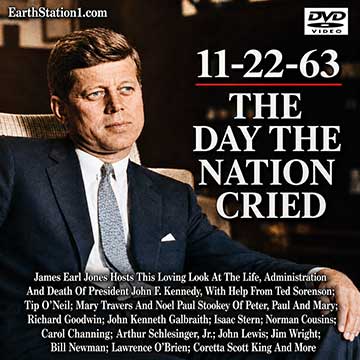
May 31, 1938: #BOTD: #HBD! Peter Yarrow,
American singer-songwriter, guitarist, and producer who found fame
with the 1960s folk music trio Peter, Paul and Mary (d. January 7,
2025) is #born in Manhattan into an educated Ukrainian Jewish
immigrant family. Yarrow co-wrote (with Leonard Lipton) one of the
group's greatest hits, "Puff, the Magic Dragon". He is
also a political activist and has supported liberal causes that
range from opposition to the Vietnam War to the creation of
Operation Respect, an organization that promotes tolerance and
civility in schools. Peter, Paul and Mary was an American folk
group formed in New York City in 1961, during the American folk
music revival phenomenon. The trio was composed of tenor and
guitarist Peter Yarrow, baritone and guitarist Noel Paul Stookey,
and contralto singer Mary Travers. The group's repertoire included
songs written by Yarrow and Stookey, early songs by Bob Dylan as
well as covers of other folk musicians. After the death of Travers
in 2009, Yarrow and Stookey continued to perform as a duo under
their individual names. Mary Travers said she was influenced by
Woody Guthrie, Pete Seeger, and the Weavers. In the documentary
Peter, Paul & Mary: Carry It On - A Musical Legacy members of
the Weavers discuss how Peter, Paul and Mary took over the torch
of the social commentary of folk music in the 1960s. The group was
inducted into the Vocal Group Hall of Fame in 1999. Peter, Paul
and Mary received the Sammy Cahn Lifetime Achievement Award from
the Songwriters Hall of Fame in 2006. Peter Yarrow died of bladder
cancer at his Upper West Side, New York City apartment after a
month in hospice care, aged 86, having been diagnosed with the
illness four years prior. His burial details are not publicly
disclosed. On Sale @ 15% Off Discount Till Midnight PT!
https://store.earthstation1.com/112263-the-day-the-nation-cried-john-f-kennedy--dvd-1122634.html
Today's
EarthStation1.com 15% Off Commemorative Memorial Title: The Secret
Story Of Terry Waite DVD MP4 Video Download USB Flash Drive
Today, May 31, 2026
May 31, 1939: #BOTD: #HBD! Terry Waite,
English humanitarian and author, is #born Terence Hardy Waite in
Bollington, Cheshire, North West England. Terence Hardy Waite CBE
was the Assistant for Anglican Communion Affairs for the then
Archbishop of Canterbury, Robert Runcie, in the 1980s. As an envoy
for the Church of England, he travelled to Lebanon as hostage
negotiator to try to secure the release of four hostages,
including the journalist John McCarthy. He was then himself taken
hostage, kidnapped by members of various clans of Islamic Jihad
and Hezbollah during the Lebanon Hostage Crisis and was held
captive from 1987 to 1991. His credibility as a trustworthy
negotiator was compromised by his involvement with U.S. Colonel
Oliver North, National Security Council staff member during the
Iran-Contra Scandal, who in the mid-1980s persued his secret
arms-for-hostage deals in the Middle East while using the
humanitarian missions of Terry Waite as a decoy to provide cover
for North's operations. After his release he wrote Taken on Trust,
a book about his experiences, and became involved in humanitarian
causes and charitable work. On Sale @ 15% Off Discount Till
Midnight PT!
https://store.earthstation1.com/the-secret-story-of-terry-waite-dvd-mp4-video-download-usb-flash-driv4.html
Today's
EarthStation1.com 15% Off Commemorative Memorial Title: The Road
To Brown: Battle Against Plessy v Ferguson DVD Download USB
Today, May 31, 2026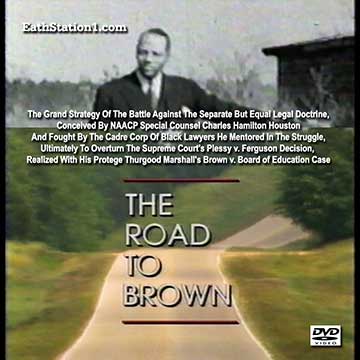
May 31, 1955: Civil Rights Movements: The
American Civil Rights Movement (1954-1968): Anti-Black Racism In
The United States: School Segregation: School Segregation In The
United States: Brown v. Board Of Education II (Brown v. Board Of
Education Of Topeka II): -- The U.S. Supreme Court expands on its
May 17, 1954 Brown v. Board Of Education decision by ordering
district courts and school districts to enforce educational
desegregation "at all deliberate speed." Although a
shocking ruling for segregationists, the court's was softened for
the South in that no implementation strategy was mandated. The
lack of provisions for a specific time frame calmed the delivery
of the ruling and reduced tensions for "the region's most
vocal extremists." The Court miscalculated how quickly their
ruling would be implemented, although the Justices were certainly
aware of the controversy their ruling would cause. Although
immediate reactions throughout the country varied, reaction to the
ruling in Southern regions of the United States was particularly
visceral. Because the initial ruling in Brown provided no
guidelines for implementation, it was not until the release of the
opinion in Brown II that the Supreme Court provided a method for
the execution of integration. The Court announced lower district
courts should pursue a "prompt and reasonable start toward
full compliance" with integration of schools following at
"all deliberate speed." There is no academic consensus
as to why the Court refused to mandate a more strict integration
policy than that of Brown II. Potential explanations have ranged
from the Court's potential desire to hide its lack of enforcement
mechanisms to guilt on behalf of the Justices for ordering
Southern segregationists to integrate. Regardless of the specific
reason for the vagueness of the implementation strategy provided,
there is no doubt that Brown initiated a pivotal shift for
American race relations. Although the desegregation of schools was
eminent, Massive Resistance to desegregation quickly spread
throughout the South, and neither Congress nor the President
showed direct support for Brown. The reaction of school boards
throughout the South to Brown was both hectic and disorganized.
Six Southern states - Alabama, Florida, Georgia, Louisiana,
Mississippi and South Carolina - do not desegregate their schools.
The phrase "all deliberate speed" was co-opted by these
states in an evasive re-interpretation of ifs meaning, claiming as
they dragged their feet on desegregation that they were
"deliberate" in the speed of desegregation. On Sale @
15% Off Discount Till Midnight PT!
https://store.earthstation1.com/the-road-to-brown-battle-against-plessy-v-ferguson-dvd-download-usb.html
Today's
EarthStation1.com 15% Off Commemorative Memorial Title: WPIX at
40! (1988) New York City's TV Channel 11 DVD, Download, USB
Today, May 31, 2026
May 31, 1958: Foundings: Business
Foundings -- Pizza Hut is launched by two brothers, Dan and Frank
Carney, both Wichita State students, as a single location in
Wichita, Kansas. Six months later they opened a second outlet, and
within a year they were operating six locations. The brothers
began franchising in 1959. The iconic Pizza Hut building style was
designed in 1963 by Chicago architect George Lindstrom and was
implemented in 1969, and Pizza Hut experienced significant growth.
Today Pizza Hut, LLC is a multinational pizza restaurant chain and
international franchise. The chain, headquartered in Plano, Texas,
operates 19,866 restaurants worldwide as of 2023. It was acquired
by PepsiCo in 1977, followed by a spin-off into Tricon Global
Restaurants, Inc., later renamed Yum! Brands in 2002, who are the
current owners. Pizza Hut introduced PizzaNet in 1994, an early
internet ordering experiment, and continued innovation with
offerings like stuffed crust pizza introduced in 1995. Pizza Hut
has adapted its model to include various restaurant formats,
including the family-style dine-in locations, carry-out, and
hybrid locations. It has ventured into international markets,
tailoring its menu to local tastes. The brand faced challenges,
including the closure of numerous dine-in locations in the US and
adjustments to its franchise operations. Despite these hurdles,
Pizza Hut remains a significant player in the global fast food
industry, known for its innovative products and marketing
strategies. On Sale @ 15% Off Discount Till Midnight PT!
https://store.earthstation1.com/wpix-at-40-channel-11-nyc-1988-tv-retrospec40111988.html
Today's
EarthStation1.com 15% Off Commemorative Memorial Title: The
Fabulous Sixties with Peter Jennings TV Docuseries MP4 Or DVD Set
Today, May 31, 2026
May 31, 1961: South Africa: The History
Of South Africa: Segregation: Racial Segregation: Apartheid
(Racial Segregation In South Africa): The South African
Constitution Of 1961 (The Founding Of The Republic Of South
Africa): -- Under the strain of British as well as international
opposition to Apartheid in South Africa, The Union Of South
Africa, which had existed since 1910, comes to an end when The
South African Constitution Of 1961 establishes the nation as The
Republic Of South Africa, and the country withdraws from the
British Commonwealth. Known informatlly as The Constitution Of
1961, it was the fundamental law of South Africa for two decades.
Under the terms of the constitution South Africa left the
Commonwealth and became a republic. The country remained outside
the Commonwealth Of Nations of The British Empire until June 1,
1994, when South Africa is returned to Commonwealth membership. On
Sale @ 15% Off Discount Till Midnight PT!
https://store.earthstation1.com/decades-the-1960s-dvd-set-peter-jennings-tv-series-3-19603.html
Today's
EarthStation1.com 15% Off Commemorative Memorial Title: Rock &
Roll An Unruly History 10 Part TV Series MP4 Video Download DVD
Today, May 31, 2026
May 31, 1964: #BOTD: #HBD! DMC (D.M.C.),
African American rapper, founding member of the hip hop group
Run-DMC, one of the pioneers of hip hop culture, is #born Darryl
Matthews McDaniels in Manhattan, New York City. Run-DMC
(Run-D.M.C., RUN DMC, or some combination thereof) was an American
hip hop group from Hollis, Queens New York City, formed in 1983 by
Joseph Simmons, Darryl McDaniels, and Jason Mizell. Run-DMC is
regarded as one of the most influential acts in the history of hip
hop culture and especially one of the most famous hip hop acts of
the 1980s. Along with Beastie Boys, LL Cool J, DJ Jazzy Jeff &
the Fresh Prince, and Public Enemy, the group pioneered new-school
hip hop music and helped usher in the golden age of hip hop. The
group was among the first to highlight the importance of the MC
and DJ relationship. With the release of Run-D.M.C. (1984),
Run-DMC became the first hip hop group to achieve a Gold record.
Run-D.M.C. was followed with the certified Platinum record King of
Rock (1985), making Run-DMC the first hip hop group to go
platinum. Raising Hell (1986) became the first multi-platinum hip
hop record. Run-DMC's cover of "Walk This Way",
featuring the group Aerosmith, charted higher on the Billboard Hot
100 than Aerosmith's original version, peaking at number four. It
became one of the best-known songs in both hip hop and rock.
Run-DMC was the first hip hop act to have their music videos
broadcast on MTV, appear on American Bandstand, be on the cover of
Rolling Stone, perform at Live Aid, and be nominated for a Grammy
Award. In 2004, Rolling Stone ranked Run-DMC at number 48 in its
list of the 100 Greatest Artists of All Time. In 2007, they were
named The Greatest Hip Hop Group of All Time by MTV and Greatest
Hip Hop Artist of All Time by VH1. In 2009, Run-DMC became the
second hip hop group (after Grandmaster Flash & the Furious
Five, 2007) to be inducted into the Rock and Roll Hall of Fame. In
2016, the group received a Grammy Lifetime Achievement Award. In
2018, Raising Hell was inducted into the National Recording
Registry by the Library of Congress as being "culturally,
historically, or aesthetically significant". On Sale @ 15%
Off Discount Till Midnight PT!
https://store.earthstation1.com/rock-amp-roll-an-unruly-history-10-part-tv-series-mp4-video-download-104.html
Today's
EarthStation1.com 15% Off Commemorative Memorial Title: Cambodia:
The Khmer Rouge And The Cambodian Genocide DVD MP4 USB Drive
Today, May 31, 2026
May 31, 1973: Resistance War Against
America): The United States In The Vietnam War: The Cambodian
Civil War: The Cambodian Campaign (The Cambodian Incursion, The
Cambodian Liberation): Aerial Operations And Battles Of The
Vietnam War: Operation Freedom Deal: -- Operation Freedom Deal:
The United States Senate votes to cut off funding for the bombing
of Khmer Rouge targets within Cambodia, hastening the end of the
Cambodian Civil War. The vote was a serious blow to President
Richard Nixon's South-East Asia policy and followed a similar
resolution voted in by the House of Representatives on May 10,
1973. The president's special adviser, Dr Henry Kissinger, had
pleaded with the senate not to rebel against the government while
he was still trying to negotiate a lasting settlement in
Indochina. He said if the communists in Vietnam realised there
were divisions in Congress, he would find it impossible to hold
them to the terms of the January 28 ceasefire. His argument held
little sway with Congress, and an amendment to an approprations
bill was sponsored by Democrat Senator Thomas Eagleton with the
support of many liberal Republicans. Large sections of the
American people wee opposed to the bombing of Cambodia, which was
reflected by senators who believed they could stop the war by
holding back funds. The Senate majority leader, Mike Mansfield,
said: "The only way to face up to our responsibilities, the
only way to do it effectively is to cut the purse strings."
Operation Freedom Deal (May 19, 1970 - August15 , 1973) was a
United States Seventh Air Force interdiction and close air support
campaign waged in Cambodia, an expansion of the Vietnam War, as
well as or the Cambodian Civil War. Launched by Richard Nixon as a
follow-up to the earlier ground invasion during the Cambodian
Campaign, the initial targets of the operation were the base areas
and border sanctuaries of The People's Army Of Vietnam (PAVN) and
the Viet Cong (VC). As time went on most of the bombing was
carried out to support the Cambodian government of Lon Nol in its
struggle against the communist Khmer Rouge. The area in which the
bombing took place was expanded to include most of the eastern
one-half of Cambodia. The bombing was extremely controversial, and
led the U.S. Congress to pass the War Powers Resolution, a federal
law intended to check the U.S. president's power to commit the
United States to an armed conflict without the consent of the U.S.
Congress. On Sale @ 15% Off Discount Till Midnight PT!
https://store.earthstation1.com/cambodia-the-khmer-rouge-and-the-cambodian-genocide-dvd-mp4-usb-driv4.html
Today's
EarthStation1.com 15% Off Commemorative Memorial Title: Watergate:
The Secret Story With Mike Wallace DVD MP4 USB Flash Drive
Today, May 31, 2026
May 31, 2005: Scandals: Political
Scandals: Political Scandals Of The United States: Richard Nixon:
The Presidency Of Richard Nixon: The Watergate Scandal: Deep
Throat: -- Vanity Fair reveals that Mark Felt was "Deep
Throat", the pseudonym given to the secret informant who
provided information in 1972 to Bob Woodward, who shared it with
Carl Bernstein. William Mark Felt Sr. (August 17, 1913 - December
18, 2008) was a Federal Bureau of Investigation (FBI) special
agent and the Bureau's Associate Director, the FBI's
second-highest-ranking post, from May 1972 until his retirement
from the FBI in June 1973. During his time as Associate Director,
Felt served as an anonymous informant, nicknamed "Deep
Throat," to reporters Bob Woodward and Carl Bernstein of The
Washington Post. He provided them with critical information about
the Watergate scandal, a scandal which ultimately led to the
resignation of President Richard M. Nixon in 1974. Though Felt's
identity as Deep Throat was strongly suspected by some in
Washington, including Nixon himself, and was speculated by many
others, it generally remained a secret for the next 30 years. In
2005, Felt finally acknowledged that he was Deep Throat, after
being persuaded by his daughter to reveal his identity. Felt
worked in several FBI field offices prior to his promotion to the
Bureau's headquarters in Washington, D.C. In 1980, Felt was
convicted of having violated the civil rights of people thought to
be associated with members of the Weather Underground, by ordering
FBI agents to break into their homes and search the premises as
part of an attempt to prevent bombings. He was ordered to pay a
fine, but was pardoned by President Ronald Reagan during his
appeal. Felt published two memoirs: The FBI Pyramid in 1979
(updated in 2006), and A G-Man's Life, written with John O'Connor,
in 2006. In 2012, the FBI released Felt's personnel file at the
agency, covering the period from 1941 to 1978. It also released
files pertaining to an extortion threat made against Felt in 1956,
though as of May 31, 2018, we have not yet found online the
details of this threat. On Sale @ 15% Off Discount Till Midnight
PT!
https://store.earthstation1.com/watergate-the-secret-story-with-mike-wallace-dvd-mp4-usb-flash-driv4.html
Today's
EarthStation1.com 15% Off Commemorative Memorial Title: Paul Is
Dead Paul McCartney Death Hoax Radio Shows MP3 CD Download USB
Today, May 31, 2026
May 31, 2019: Broadcasting: The History
Of Broadcasting: Radio Broadcasting: The History Of Radio
Broadcasting: The History Of American Radio Broadcasting:
Sign-Offs: -- WPLJ (95.5 FM), which was by this time a New York
oldies radio station, signs off after playing first John Lennon's
Imagine, then the song WPLJ (White Port Lemon Juice) performed by
Hal l& Oates at the station some years prior, then The End by
The Beatles; after a farewell toast, the station sent silent for a
couple of minutes, then it became the Christian Rock station
K-Love. #WPLJ #95.5FM #NewYork #Oldies #RadioStations
#SignOffs#ChristianRockRadioStations #K-Love #MP3 #AudioDOwnload
#DVD On Sale @ 15% Off Discount Till Midnight PT!
https://store.earthstation1.com/paul-is-dead-mp3-cd-paul-mccartney-death-hoax-radio-show3.html
Today's
EarthStation1.com #OnThisDay Commemorative Memorial Title: The
Historical View A Legacy In Pictures JPG Image Set CD Download USB
Today, May 31, 2026 May 1: Chronology: Calendars: The Months
Of The Year: -- The month of May ends, the fifth month of the year
in the Gregorian and Julian calendars. Its length is 31 days. May
is a month of spring in the Northern Hemisphere, and autumn in the
Southern Hemisphere. Therefore, May in the Southern Hemisphere is
the seasonal equivalent of November in the Northern Hemisphere and
vice versa. Late May typically marks the start of the summer
vacation season in the United States (Memorial Day) and Canada
(Victoria Day) that ends on Labor Day, the first Monday of
September. May (in Latin, Maius) was named for the Greek goddess
Maia, who was identified with the Roman era goddess of fertility,
Bona Dea, whose festival was held in May. Conversely, the Roman
poet Ovid provides a second etymology, in which he says that the
month of May is named for the maiores, Latin for "elders",
and that the following month (June) is named for the iuniores, or
"young people" (Fasti VI.88). Eta Aquariids meteor
shower appears in May. It is visible from about April 21 to about
May 20 each year with peak activity on or around May 6. The
Arietids shower from May 22 - July 2, and peaks on June 7. The
Virginids also shower at various dates in May. Under the calendar
of ancient Rome, the festival of Bona Dea fell on May 1, Argei
fell on May 14 or May 15, Agonalia fell on May 21, and Ambarvalia
on May 29. Floralia was held April 27 during the Republican era,
or April 28 on the Julian calendar, and lasted until May 3.
Lemuria fell on 9,11, and 13 May under the Julian calendar. The
College of Aesculapius and Hygia celebrated two festivals of
Rosalia, one on May 11 and one on May 22. Rosalia was also
celebrated at Pergamon on May 24-26. A military Rosalia festival,
Rosaliae signorum, also occurred on May 31. Ludi Fabarici was
celebrated May 29 - June 1. Mercury would receive a sacrifice on
the Ides of May (May 15). Tubilustrium took place on May 23 as
well as in March. These dates do not correspond to the modern
Gregorian calendar. May's birthstone is the emerald which is
emblematic of love and success. Birth flowers are the Lily of the
Valley and Crataegus monogyna. Both are native throughout the cool
temperate Northern Hemisphere in Asia, Europe, and in the southern
Appalachian Mountains in the United States, but have been
naturalized throughout the temperate climatic world. The
"Mayflower" Epigaea repens is a North American harbinger
of May, and the floral emblem of both Nova Scotia and
Massachusetts. Its native range extends from Newfoundland south to
Florida, west to Kentucky in the southern range, and to Northwest
Territories in the north. The zodiac signs are Taurus (until May
20) and Gemini (May 21 onward). On Sale @ 15% Off Discount Till
Midnight PT!
https://store.earthstation1.com/the-historical-view-a-legacy-in-pictures-jpg-photo-cd.html
May 1: Chronology: Calendars: The Months
Of The Year: -- The month of May ends, the fifth month of the year
in the Gregorian and Julian calendars. Its length is 31 days. May
is a month of spring in the Northern Hemisphere, and autumn in the
Southern Hemisphere. Therefore, May in the Southern Hemisphere is
the seasonal equivalent of November in the Northern Hemisphere and
vice versa. Late May typically marks the start of the summer
vacation season in the United States (Memorial Day) and Canada
(Victoria Day) that ends on Labor Day, the first Monday of
September. May (in Latin, Maius) was named for the Greek goddess
Maia, who was identified with the Roman era goddess of fertility,
Bona Dea, whose festival was held in May. Conversely, the Roman
poet Ovid provides a second etymology, in which he says that the
month of May is named for the maiores, Latin for "elders",
and that the following month (June) is named for the iuniores, or
"young people" (Fasti VI.88). Eta Aquariids meteor
shower appears in May. It is visible from about April 21 to about
May 20 each year with peak activity on or around May 6. The
Arietids shower from May 22 - July 2, and peaks on June 7. The
Virginids also shower at various dates in May. Under the calendar
of ancient Rome, the festival of Bona Dea fell on May 1, Argei
fell on May 14 or May 15, Agonalia fell on May 21, and Ambarvalia
on May 29. Floralia was held April 27 during the Republican era,
or April 28 on the Julian calendar, and lasted until May 3.
Lemuria fell on 9,11, and 13 May under the Julian calendar. The
College of Aesculapius and Hygia celebrated two festivals of
Rosalia, one on May 11 and one on May 22. Rosalia was also
celebrated at Pergamon on May 24-26. A military Rosalia festival,
Rosaliae signorum, also occurred on May 31. Ludi Fabarici was
celebrated May 29 - June 1. Mercury would receive a sacrifice on
the Ides of May (May 15). Tubilustrium took place on May 23 as
well as in March. These dates do not correspond to the modern
Gregorian calendar. May's birthstone is the emerald which is
emblematic of love and success. Birth flowers are the Lily of the
Valley and Crataegus monogyna. Both are native throughout the cool
temperate Northern Hemisphere in Asia, Europe, and in the southern
Appalachian Mountains in the United States, but have been
naturalized throughout the temperate climatic world. The
"Mayflower" Epigaea repens is a North American harbinger
of May, and the floral emblem of both Nova Scotia and
Massachusetts. Its native range extends from Newfoundland south to
Florida, west to Kentucky in the southern range, and to Northwest
Territories in the north. The zodiac signs are Taurus (until May
20) and Gemini (May 21 onward). On Sale @ 15% Off Discount Till
Midnight PT!
https://store.earthstation1.com/the-historical-view-a-legacy-in-pictures-jpg-photo-cd.html
Today's
EarthStation1.com #OnThisDay Commemorative Memorial Title: The Old
Time Radio Adventure MegaSet MP3 DVD, Download, USB Drive
Today, May 31, 2026May 31: National Fisherfolk Day
(Phillippines): -- On this day, Filipinos all across the country
get together to show their appreciation for those who are on the
frontline of fishing and also those who have pledged to keep
fishing sustainable, fighting against illegal practices within the
community. Because the Philippines has an important fishing
market, this day also brings awareness to the relevance of
fisherfolk to the country's economy. Since 2000, National
Fisherfolk Day is celebrated annually across the Philippines. It
was through the Presidential Proclamation 261 series that the
holiday became a federal celebration. The event's goal is to bring
awareness to the work done by thousands of people every day in the
country. Since fishing is one of the main economical contributions
to the Philippines, fisherfolk are responsible for providing food
not only for their own families but for the entire country. Not
only that, but the holiday has, since 2015, also celebrated the
sustainable actions taken by the government to prevent illegal
practices and unregulated fishing within the coastal regions of
the Philippines. There had been issues regarding illegal
activities in the fishing market for a long time and in 2002
fisherfolk from eight different alliances came together to form
the Fisherfolk Movement of the Philippines. The group demanded
better regulations in the trade market, stronger policies
regarding sustainable practices, and more unity among all small
producers and fisherfolk in the country. In 2005, this group
promoted a "fluvial parade", in which fisherfolk
protested in Hong Kong at a World Trade Organization meeting.
Another similar movement happened again in 2006. However, it was
only in 2015, under the government of Benigno Aquino III, that the
government finally took action and regulated the fishing market to
have better conditions and better contain illegal practices with
the Republic Act 10654. On Sale @ 15% Off Discount Till Midnight
PT!
https://store.earthstation1.com/the-old-time-radio-adventure-mp3-dvd-megase3.html
Today's
EarthStation1.com #OnThisDay Commemorative Memorial Title: Bigot
Songs: Ethnic Prejudice Audio Recordings CD, MP3 Download, USB
Today, May 31, 2026May 31, 1809: #DOTD: #RIP: Joseph Haydn,
Austrian pianist and composer of the Classical period (b. March
31, 1732) #dies peacefully in his own home at 12:40 a.m., aged 77,
having suffered from weakness, dizziness, inability to concentrate
and painfully swollen legs since 1803. On June 15, a memorial
service was held in the Schottenkirche at which Mozart's Requiem
was performed. Haydn's remains were interred in the local
Hundsturm cemetery until 1820, when they were moved to Eisenstadt
by Prince Nikolaus. His head took a different journey; it was
stolen by phrenologists shortly after burial, and the skull was
reunited with the other remains only in 1954, now interred in a
tomb in the north tower of the Bergkirche. Joseph Haydn was born
Franz Joseph Haydn in Rohrau, Austria, a village that at that time
stood on the border with Hungary. He was instrumental in the
development of chamber music such as the piano trio. His
contributions to musical form have earned him the epithets "Father
of the Symphony" and "Father of the String Quartet".
Haydn spent much of his career as a court musician for the wealthy
Esterhazy family at their remote estate. Until the later part of
his life, this isolated him from other composers and trends in
music so that he was, as he put it, "forced to become
original". Yet his music circulated widely, and for much of
his career he was the most celebrated composer in Europe. He was a
friend and mentor of Mozart, a tutor of Beethoven, and the older
brother of composer Michael Haydn. On Sale @ 15% Off Discount Till
Midnight PT!
https://store.earthstation1.com/bigot-songs-mp3-cd-ethnic-prejudice-audio-recording3.html
Today's
EarthStation1.com #OnThisDay Commemorative Memorial Title: A Duke
Named Ellington TV Series Duke Ellington DVD Download USB Drive
Today, May 31, 2026May 31, 1967: #DOTD: #RIP: Billy
Strayhorn, African American jazz composer, pianist, lyricist, and
arranger, best known for his successful collaboration with
bandleader and composer Duke Ellington, lasting nearly three
decades (b. November 29, 1915) #dies of esophageal cancer in the
early morning in the company of his partner, Bill Grove, not in
Lena Horne's arms as has often been falsely reported (by her own
account, she was touring in Europe when she received the news of
Strayhorn's death). His ashes were scattered by a gathering of his
closest friends in the Hudson River at the 79th Street boat basin
near the foot of New York City's Riverside Park. While in the
hospital, he had submitted his final composition to Ellington.
"Blood Count" was used as the third track to Ellington's
memorial album for Strayhorn, "And His Mother Called Him
Bill", which was recorded several months after Strayhorn's
death. The last track of the album is a spontaneous solo version
of "Lotus Blossom" performed by Ellington, who sat at
the piano and played for his friend while the band (who can be
heard in the background) were packing up after the formal end of
the recording session. Billy Strayhorn was born William Thomas
Strayhorn in Dayton, Ohio. Billy Strayhorn's compositions include
"Take the 'A' Train", "Lush Life", "Chelsea
Bridge" and "A Flower Is a Lovesome Thing". His
family moved to the Homewood section of Pittsburgh, Pennsylvania
soon after he was born. However, his mother's family was from
Hillsborough, North Carolina, and she sent him there to protect
him from his father's drunken sprees. Strayhorn spent many months
of his childhood at his grandparents' house in Hillsborough. In an
interview, Strayhorn said that his grandmother was his primary
influence during the first ten years of his life. He first became
interested in music while living with her, playing hymns on her
piano, and playing records on her Victrola record player.
Strayhorn returned to Pittsburgh, and attended Westinghouse High
School, later attended by Erroll Garner and Ahmad Jamal. In
Pittsburgh, he began his musical career, studying classical music
for a time at the Pittsburgh Music Institute, writing a high
school musical, forming a musical trio that played daily on a
local radio station, and, while still in his teens, composing
(with lyrics) the songs "Life Is Lonely" (later renamed
"Lush Life"), "My Little Brown Book", and
"Something to Live For". While still in grade school, he
worked odd jobs to earn enough money to buy his first piano, and
took lessons from Charlotte Enty Catlin. While in high school, he
played in the school band, and studied under Carl McVicker, who
had also instructed jazz pianists Erroll Garner and Mary Lou
Williams. By age 19, he was writing for a professional musical,
Fantastic Rhythm. Though classical music was Strayhorn's first
love, his ambition to become a classical composer was shot down by
the harsh reality of a black man trying to make it in the
classical world, which at that time was almost completely white.
Strayhorn was then introduced to the music of pianists like Art
Tatum and Teddy Wilson at age 19. The artistic influence of these
musicians guided him into the realm of jazz where he remained for
the rest of his life. His first jazz exposure was in a combo
called the Mad Hatters that played around Pittsburgh. Strayhorn's
fellow students, guitarist Bill Esch and drummer Mickey Scrima,
also influenced his move towards jazz, and he began writing
arrangements for Buddy Malone's Pittsburgh dance band after 1937.
He met Duke Ellington in December 1938, after an Ellington
performance in Pittsburgh (he had first seen Ellington play in
Pittsburgh in 1933). Here he first told, and then showed the band
leader how he would have arranged one of Duke's own pieces.
Ellington was impressed enough to invite other band members to
hear Strayhorn. At the end of the visit, he arranged for Strayhorn
to meet him when the band returned to New York. Strayhorn worked
for Ellington for the next quarter century as an arranger,
composer, occasional pianist and collaborator until his early
death from cancer. As Ellington described him, "Billy
Strayhorn was my right arm, my left arm, all the eyes in the back
of my head, my brain waves in his head, and his in mine."
Strayhorn's relationship with Ellington was always difficult to
pin down: Strayhorn was a gifted composer and arranger who seemed
to flourish in Duke's shadow. Ellington was arguably a father
figure and the band was affectionately protective of the
diminutive, mild-mannered, unselfish Strayhorn, nicknamed by the
band "Strays", "Weely", and "Swee' Pea".
Ellington may have taken advantage of him, but not in the
mercenary way in which others had taken advantage of Ellington;
instead, he used Strayhorn to complete his thoughts and introduce
new musical ideas, while giving him the freedom to write on his
own and enjoy at least some of the credit he deserved. Though Duke
Ellington took credit for much of Strayhorn's work, he did not
maliciously drown out his partner. Ellington would make jokes
onstage like, "Strayhorn does a lot of the work but I get to
take the bows!" On the other hand, Ellington did not oppose
his publicists' frequently crediting him without any mention of
Strayhorn, and, despite the latter's attempts to hide his
dissatisfaction, "Strayhorn revealed", at least to his
friends, "a deepening well of unease about his lack of public
recognition as Ellington's prominence grew." Strayhorn
composed the band's best known theme, "Take the 'A' Train",
and a number of other pieces that became part of the band's
repertoire. In some cases Strayhorn received attribution for his
work such as "Lotus Blossom", "Chelsea Bridge",
and "Rain Check", while others, such as "Day Dream"
and "Something to Live For", were listed as
collaborations with Ellington or, in the case of "Satin Doll"
and "Sugar Hill Penthouse", were credited to Ellington
alone. Strayhorn also arranged many of Ellington's
band-within-band recordings and provided harmonic clarity, taste,
and polish to Duke's compositions. On the other hand, Ellington
gave Strayhorn full credit as his collaborator on later, larger
works such as Such Sweet Thunder, A Drum Is a Woman, The Perfume
Suite and The Far East Suite, where Strayhorn and Ellington worked
closely together. Strayhorn also often sat in on the piano with
the Ellington Orchestra, both live and in the studio. Detroit Free
Press music critic Mark Stryker concludes that the work of
Strayhorn and Ellington in the score of the 1959 Hollywood film
Anatomy of a Murder, Otto Preminger's 1959 American courtroom
drama crime film, is "indispensable, [although] ... too
sketchy to rank in the top echelon among Ellington-Strayhorn
masterpiece suites like Such Sweet Thunder and The Far East Suite,
but its most inspired moments are their equal." Film
historians have recognized the soundtrack "as a landmark-the
first significant Hollywood film music by African Americans
comprising non-diegetic music, that is, music whose source is not
visible or implied by action in the film, like an on-screen band."
The score "avoided the cultural stereotypes that previously
characterized jazz scores and rejected a strict adherence to
visuals in ways that presaged the New Wave cinema of the '60s."
In 1960 the two collaborated on the album The Nutcracker Suite,
recorded for the Columbia label and featuring jazz interpretations
of "The Nutcracker" by Tchaikovsky, arranged by the two.
The original album cover is notable for the inclusion of
Strayhorn's name and picture along with Ellington's on the front.
Shortly before going on his second European tour with his
orchestra, from March to May 1939, Ellington announced to his
sister Ruth and son Mercer Ellington that Strayhorn "is
staying with us." Through Mercer, Strayhorn met his first
partner, African American musician Aaron Bridgers, with whom
Strayhorn lived until Bridgers moved to Paris in 1947. Strayhorn
was openly gay. He participated in many civil rights causes. As a
committed friend to Martin Luther King Jr., he arranged and
conducted "King Fit the Battle of Alabama'" for the
Ellington Orchestra in 1963 for the historical revue (and album)
My People, dedicated to King. Strayhorn's strong character left an
impression on many people who met him. He had a major influence on
the career of Lena Horne, who wanted to marry Strayhorn and
considered him to have been the love of her life. Strayhorn used
his classical background to improve Horne's singing technique.
They eventually recorded songs together. In the 1950s, Strayhorn
left his musical partner Duke Ellington for a few years to pursue
a solo career of his own. He released a few solo albums and revues
for the Copasetics (a New York show-business society), and took on
theater productions with his friend Luther Henderson. Strayhorn's
arrangements had a tremendous impact on the Ellington band.
Ellington always wrote for the personnel he had at the time,
showcasing both the personalities and sound of soloists such as
Johnny Hodges, Harry Carney, Ben Webster, Lawrence Brown and Jimmy
Blanton, and drawing on the contrasts between players or sections
to create a new sound for his band. Strayhorn brought a more
linear, classically schooled ear to Ellington's works, setting
down in permanent form the sound and structures that Ellington
sought. A Pennsylvania State Historical Marker highlighting
Strayhorn's accomplishments was placed at Westinghouse High School
in Pittsburgh, from which he graduated. In North Carolina, a state
historical marker honoring Strayhorn is located in downtown
Hillsborough, near his "boyhood home". The former Regent
Theatre in Pittsburgh's East Liberty neighborhood was renamed the
Kelly Strayhorn Theater in honor of Strayhorn and fellow
Pittsburgher Gene Kelly in 2000. It is a community-based
performing arts theater. In 2015 Strayhorn was inducted into the
Legacy Walk. In his autobiography and in a spoken word passage in
his Second Sacred Concert, Duke Ellington listed what he
considered Strayhorn's "four major moral freedoms":
"freedom from hate, unconditionally; freedom from self-pity
(even through all the pain and bad news); freedom from fear of
possibly doing something that might possibly help another more
than it might himself and freedom from the kind of pride that
might make a man think that he was better than his brother or his
neighbor." On Sale @ 15% Off Discount Till Midnight PT!
https://store.earthstation1.com/a-duke-named-ellington-dvd-complete-2-part-tv-serie2.html
Today's
EarthStation1.com #OnThisDay Commemorative Memorial Title: It Was
Twenty Years Ago Today: 1967 & Sgt. Pepper DVD MP4 USB Drive
Today, May 31, 2026May 31, 1996: #DOTD: #RIP: Timothy Leary,
American psychologist and author known for his strong advocacy of
psychedelic drugs (b. October 22, 1920) #dies in Beverly Hills,
California of inoperable prostate cancer, aged 75. In the months
leading up to his death, his website team, led by Chris Graves,
updated his website on a daily basis as a proto-blog. The website
noted his daily intake of various illicit and legal chemical
substances, with a predilection for nitrous oxide, LSD and other
psychedelic drugs. He was also noted for his trademark "Leary
Biscuit", a cannabis edible consisting of a snack cracker
with cheese and a small marijuana bud, briefly microwaved. At his
request, his sterile house was redecorated by the staff with an
array of surreal ornamentation. In his final months, thousands of
visitors, well-wishers and old friends visited him in his
California home. Until his last weeks, he gave many interviews
discussing his new philosophy of embracing death. Leary's last
book was Chaos & Cyber Culture, published in 1994. In it he
wrote: "The time has come to talk cheerfully and joke sassily
about personal responsibility for managing the dying process."
His book Design for Dying, which tried to give a new perspective
on death and dying, was published posthumously. Leary wrote about
his belief that death is "a merging with the entire life
process". His death was videotaped for posterity at his
request by Denis Berry, trustee of Leary's archives, and Joey
Cavella, who had filmed Leary during his later years, capturing
his final words. According to his son Zachary, during his final
moments, he clenched his fist and said: "Why?", then,
unclenching his fist, said: "Why not?". He uttered the
phrase repeatedly, in different intonations, and died soon after.
His last word, according to Zach, was "beautiful".
Leary's remains were cremated, and ashes were given to close
friends and family. In 2015, Susan Sarandon brought some of his
ashes to the Burning Man festival in Black Rock City, Nevada, and
put them into an art installation there. The ashes were burned
along with the installation on September 6, 2015. A quarter ounce
of Leary's ashes were arranged by his friend at Celestis to be
buried in space aboard a rocket carrying the remains of 23 others,
including Star Trek creator Gene Roddenberry, space colonization
advocate Gerard O'Neill and German-American rocket engineer Krafft
Ehricke. A Pegasus rocket containing their remains was launched on
April 21, 1997, and remained in orbit for six years until it
burned up in the atmosphere. Timothy Leary was born Timothy
Francis Leary into an Irish Catholic household as an only child in
Springfield, Massachusetts. Evaluations of Leary are polarized,
ranging from "bold oracle" to "publicity hound".
According to poet Allen Ginsberg, he was "a hero of American
consciousness", while writer Tom Robbins called him a "brave
neuronaut". President Richard Nixon disagreed, calling Leary
"the most dangerous man in America". During the 1960s
and 1970s, at the height of the counterculture movement, Leary was
arrested 36 times. As a clinical psychologist at Harvard
University, Leary founded the Harvard Psilocybin Project after a
revealing experience with magic mushrooms he had in Mexico in
1960. For two years, he tested psilocybin's therapeutic effects,
in the Concord Prison Experiment and the Marsh Chapel Experiment.
He also experimented with lysergic acid diethylamide (LSD), which
was also legal in the U.S. at the time. Other Harvard faculty
questioned his research's scientific legitimacy and ethics because
he took psychedelics himself along with his subjects and allegedly
pressured students to join in. Harvard fired Leary and his
colleague Richard Alpert (later known as Ram Dass) in May 1963.
Many people learned of psychedelics after the Harvard scandal.
Leary continued to publicly promote psychedelic drugs and became a
well-known figure of the counterculture of the 1960s; he
popularized catchphrases that promoted his philosophy, such as
"turn on, tune in, drop out", "set and setting",
and "think for yourself and question authority". On May
19, 1969, the same day that The United States Supreme Court
overturned his 1966 marihuana possession conviction by declaring
the historic Marihuana Tax Act Of 1937 under which he was
convicted unconstitutional, Leary announced his candidacy for
governor of California against the Republican incumbent, Ronald
Reagan. His campaign slogan was "Come together, join the
party." Twenty two days later, on June 1, 1969, Leary joined
John Lennon and Yoko Ono at their Montreal bed-in, and Lennon
subsequently wrote Leary a campaign song, "Come Together",
a number one single and the first track of the last album The
Beatles recorded, "Abbey Road". Leary believed that LSD
showed potential for therapeutic use in psychiatry. He developed
an eight-circuit model of consciousness in his 1977 book
Exo-Psychology and gave lectures, occasionally calling himself a
"performing philosopher". He also developed a philosophy
of mind expansion and personal truth through LSD. He also wrote
and spoke frequently about transhumanism, human space migration,
intelligence increase, and life extension. On Sale @ 15% Off
Discount Till Midnight PT!
https://store.earthstation1.com/it-was-20-years-ago-today-1967-and-sgt-pepp201967.html
Today's
EarthStation1.com #OnThisDay Commemorative Memorial Title: WWII
Films: Homefront U.S.A. Collection DVD, Video Download, USB Drive
Today, May 31, 2026May 31, 1983: #DOTD: #RIP: Jack Dempsey,
American boxer and soldier, nicknamed Kid Blackie and The Manassa
Mauler (b. June 24, 1895) #dies of heart failure at the age of 87
in New York City. His body is buried at Southampton Cemetery in
Southampton, New York. Jack Dempsey was born William Harrison
Dempsey in Manassa, Colorado. Dempsey competed as a professional
boxerfrom 1914 to 1927, and reigned as the world heavyweight
champion from 1919 to 1926. A cultural icon of the 1920s,
Dempsey's aggressive fighting style and exceptional punching power
made him one of the most popular boxers in history. Many of his
fights set financial and attendance records, including the first
million-dollar gate, and pioneered the live broadcast of sporting
events in general, and boxing matches in particular. Dempsey is
ranked tenth on The Ring magazine's list of all-time heavyweights
and seventh among its Top 100 Greatest Punchers, while in 1950 the
Associated Press voted him as the greatest fighter of the past 50
years. He is a member of the International Boxing Hall of Fame,
and was in the previous Boxing Hall of Fame. On September 22,
1927, Dempsey famously lost the "Long Count" boxing
match to Gene Tunney. The Long Count Fight, also known as the
Battle of the Long Count, was a professional boxing rematch
between world heavyweight champion Gene Tunney and former champion
Jack Dempsey. It took place on September 22, 1927, at Soldier
Field in Chicago. "Long Count" is applied to the fight
because when Tunney was down the count was delayed due to
Dempsey's failure to go to and remain in a neutral corner. Whether
this "long count" actually affected the outcome remains
a subject of debate. On Sale @ 15% Off Discount Till Midnight PT!
https://store.earthstation1.com/wwii-films-homefront-usa-dvd.html
Today's
EarthStation1.com #OnThisDay Commemorative Memorial Title: The
Divided Union: American Civil War TV Series MP4 Download DVD Set
Today, May 31, 2026May 31-June 1, 1862: The American Civil
War (The Civil War, The War Between The States): The Eastern
Theater Of The American Civil War: The Peninsula Campaign (The
Peninsular Campaign): The Battle Of Seven Pines (The Battle Of
Fair Oaks, The Battle Of Fair Oaks Station): -- The culmination of
an offensive up the Virginia Peninsula by Union Maj. Gen. George
B. McClellan, in which The Army Of The Potomac reached the
outskirts of Richmond, begins as The Battle Of Seven Pines takes
place in Henrico County, Virginia, nearby Sandston. . On May 31,
Confederate General Joseph E. Johnston attempted to overwhelm two
Federal corps that appeared isolated south of the Chickahominy
River. The Confederate assaults, although not well coordinated,
succeeded in driving back the IV Corps and inflicting heavy
casualties. Reinforcements arrived, and both sides fed more and
more troops into the action. Supported by the III Corps and Maj.
Gen. John Sedgwick's division of Maj. Gen. Edwin V. Sumner's II
Corps (which crossed the rain-swollen river on Grapevine Bridge),
the Federal position was finally stabilized. Gen. Johnston was
seriously wounded during the action, and command of the
Confederate army devolved temporarily to Maj. Gen. G.W. Smith. On
June 1, the Confederates renewed their assaults against the
Federals, who had brought up more reinforcements, but made little
headway. Both sides claimed victory. Although the battle was
tactically inconclusive, it was the largest battle in the Eastern
Theater up to that time (and second only to Shiloh in terms of
casualties thus far, about 11,000 total). Gen. Johnston's injury
also had profound influence on the war: it led to the appointment
of Robert E. Lee as Confederate commander. The more aggressive Lee
initiated the Seven Days Battles, leading to a Union retreat in
late June. Seven Pines therefore marked the closest Union forces
came to Richmond in this offensive. On Sale @ 15% Off Discount
Till Midnight PT!
https://store.earthstation1.com/the-divided-union-american-civil-war-tv-series-3-dual-layer-dvd3.html
Today's
EarthStation1.com #OnThisDay Commemorative Memorial Title: Civil
Rights OTR: Destination Freedom, New World A-Coming CD MP3 USB
Today, May 31, 2026May 31, 1964: Civil Rights Movements: The
American Civil Rights Movement (1954-1968): Anti-Black Racism In
The United States: School Segregation: School Segregation In The
United States: Taylor v. Board Of Education Of City School
District Of New Rochelle: -- Judge Irving Kaufman orders the Board
Of Education of New Rochelle, N.Y. to integrate schools, according
to the court's ruling of January 24. The court's order of May 31
reads: "In an opinion dated January 24, 1961, this Court
found that the Board of Education of the City of New Rochelle had
intentionally created and maintained the Lincoln Elementary School
as a racially segregated school, and had not acted in good faith
to implement desegregation as required by the Fourteenth
Amendment. It was the Court's position that since the Board was
responsible for the segregated condition at the Lincoln School, it
owed the community the primary obligation to correct it." On
Sale @ 15% Off Discount Till Midnight PT!
https://store.earthstation1.com/destination-freedom-new-world-a39comin39-mp3-cd-civil-rights-39393.html
Today's
EarthStation1.com #OnThisDay Commemorative Memorial Title: School
Segregation: Little Rock & Boston MP4 Video Download DVD
Today, May 31, 2026May 31, 1964: Taylor v. Board Of
Education Of City School District Of New Rochelle: Judge Irving
Kaufman orders the Board Of Education of New Rochelle, N.Y. to
integrate schools, according to the court's ruling of January 24.
The court's of May 31 reads: "In an opinion dated January 24,
1961, this Court found that the Board of Education of the City of
New Rochelle had intentionally created and maintained the Lincoln
Elementary School as a racially segregated school, and had not
acted in good faith to implement desegregation as required by the
Fourteenth Amendment. It was the Court's position that since the
Board was responsible for the segregated condition at the Lincoln
School, it owed the community the primary obligation to correct
it." On Sale @ 15% Off Discount Till Midnight PT!
https://store.earthstation1.com/school-segregation-little-rock-amp-boston-mp4-video-download-dv4.html
Today's
EarthStation1.com #OnThisDay Commemorative Memorial Title: Damn
The Defiant! H.M.S. Defiant 1962 RN Alec Guinness DVD MP4 USB
Today, May 31, 2026May 31, 1805: The Age Of Enlightenment
(The Enlightenment, The Age Of Reason): The Age Of Revolution: The
Atlantic Revolutions: The French Revolution: The French
Revolutionary And Napoleonic Wars (The Great French War) (The
French Revolutionary Wars, The Napoleonic Wars): The Napoleonic
Wars: Naval Battles Of The Napoleonic Wars: The Coalition Wars:
The War Of The Third Coalition: The Trafalgar Campaign: The Battle
Of Diamond Rock: -- French and Spanish forces begin the assault
against British forces occupying Diamond Rock, a 574 foot basalt
island located next to Fort-de-France in Martinique. The Battle of
Diamond Rock took place between May 31 and June 2, 1805. It was an
attempt by Franco-Spanish force despatched under Captain Julien
Cosmao to retake Diamond Rock, at the entrance to the bay leading
to Fort-de-France, from the British forces that had occupied it
over a year before. The French in Martinique had been unable to
oust the defenders from the strategically important rock, and the
British garrison was able to control access to Fort-de-France Bay,
firing on ships attempting to enter it with guns they had placed
on the cliffs. The arrival of a large combined Franco-Spanish
fleet in May changed the strategic situation. The French
commander, Pierre de Villeneuve, had vague orders to attack
British possessions in the Caribbean, but instead waited at
Martinique for clearer instructions. He was finally persuaded to
authorize an assault on the British position, and a Franco-Spanish
flotilla was despatched to storm the rock. Already short of water,
the defenders held on in the summit for several days, while the
French, who had neglected to bring scaling ladders, could make
little headway. The British, short of both water and ammunition,
eventually negotiated the surrender of the rock after several days
under fire. As Diamond Rock was legally considered a Royal Navy
vessel, and commander James Wilkes Maurice was legally "captain"
of it, after repatriation, he was tried by court-martial (as the
law dictated in any case where a captain loses his ship,
regardless of the cause), but was honourably acquitted. On Sale @
15% Off Discount Till Midnight PT!
https://store.earthstation1.com/damn-the-defiant-alec-guinness-napoleonic-british-naval-dvd.html
Today's
EarthStation1.com #OnThisDay Commemorative Memorial Title: Voice
Of The Army WWII Radio Series MP3 Set CD, Download, USB Drive
Today, May 31, 2026May 31, 2001: #DOTD: #RIP: Arlene
Francis, Armenian American actress, talk show host, game show
panelist, and television personality (b. October 20, 1907) #dies
at the age of 93 in San Francisco, California from Alzheimer's
disease and cancer. She is interred in Roosevelt Memorial Park in
Trevose, Pennsylvania. Arlene Francis was born Arline Francis
Kazanjian in Boston, Massachusetts. She is known for her
long-running role as a panelist on the television game show What's
My Line?, on which she regularly appeared for 25 years, from 1950
to 1975, on both the network and syndicated versions of the show.
On Sale @ 15% Off Discount Till Midnight PT!
https://store.earthstation1.com/voice-of-the-army-mp3-cd-complete-world-war-ii-radio-serie3.html
Today's
EarthStation1.com #OnThisDay Commemorative Memorial Title:
Television: A History Of Broadcast TV DVD MP4 Download USB Drive
Today, May 31, 2026May 31, 2013: #DOTD: #RIP: Jean
Stapleton, American character actress of stage, television and
film, popularly known as the perpetually optimistic and devoted
wife of Archie Bunker on the 1970s sitcom All in the Family, a
role that earned her three Emmys and two Golden Globes for Best
Actress in a comedy series (b. January 19, 11923) #dies of natural
causes at her apartment in Manhattan at age 90. Norman Lear said,
"No one gave more profound 'how to be a human being' lessons
than Jean Stapleton." Roseanne Barr said that Stapleton's
range was "unbelievable, deep, and majestic." Co-star
Rob Reiner said, "Working with her was one of the greatest
experiences of my life." Sally Struthers said, "Jean
lived so in the present. She was a Christian Scientist who didn't
say or think a negative thing ... She was just a walking, living
angel". The marquee lights on Broadway were dimmed for two
minutes on June 5, 2013, at 8 p.m. EDT, to honor the memory of
Stapleton. She is buried at Lincoln Cemetery in Chambersburg,
Pennsylvania. Jean Stapleton was born Jeanne Murray in Manhattan,
the daughter of Marie A. Stapleton, an opera singer, and Joseph E.
Murray, a billboard advertising salesman. She made occasional
appearances on the All in the Family follow-up series Archie
Bunker's Place, but asked to be written out of the show during the
first season due to becoming tired of the role. On Sale @ 15% Off
Discount Till Midnight PT!
https://store.earthstation1.com/television-1988-tv-documentary-series-8-shows-4-dual-laye198884.html